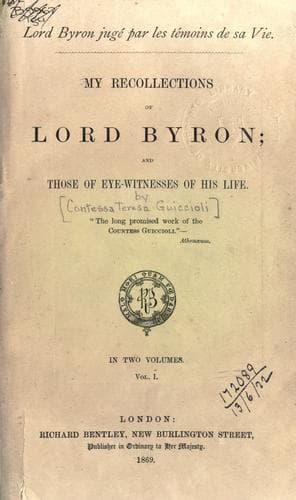
My Recollections of Lord ByronGuiccioli, Teresa, contessa di
General
My Recollections of Lord Byron
Guiccioli, Teresa, contessa di
Byron, George Gordon Byron, Baron, 1788-1824; Poets, English -- 19th century -- Biography
At that time, what Byron could not find in his real and historical
subject, he took from another reality, which was himself,--that is, his
own qualities, the circumstances of his life, his tastes; without ever
inquiring whether Conrad's fear at the sight of the mysterious drop of
blood on Gulnare's forehead was that of Byron, whether the Venetian
renegade Alp could really experience the horror which Byron did at
Constantinople at the sight of dogs feasting upon human carcasses; or
whether the association of the qualities with which he idealized his
heroes would not induce psychologists to accuse him of sinning against
truth, of destroying the unity of a Corsair's nature.
In this Lord Byron confided in his powers. He felt that the love of
truth, and of what is beautiful, was too strong in him ever to depart
from or cause him to violate the essential rules of art; but he wished
to remain a poet while trusting in reality.
When he went to the East, and found himself there in contact with
outward circumstances so in harmony with the natural bent of his views,
and in presence of men like Ali Pasha, of whose victims he could almost
hear the moans and the screams "in the clime"
"Where all save the spirit of man is divine;
Where wild as the accents of lovers' farewell
Are the hearts which they bear and the tales which they tell,"
he felt that he was at last in the land most likely to fire his natural
genius, and to permit of his satisfying the imperious want which his
observing mind constantly experienced of resting upon reality and upon
truth. The terrible Ali Pasha of Yanina was especially the type which
attracted his notice. "Ali Pasha," says Galt, "is at the bottom of all
his Oriental heroes. His 'Corsair' is almost the history of Ali Pasha."
In the "Bride of Abydos" the old Giaffir is again Ali. As for "Lara," it
is thought that Byron conceived him on being very strongly impressed by
the sight of a nobleman who was accused of murder, and who was pointed
out to him at the Cagliari theatre. "I always thought," says Galt, who
was present on the occasion, "that this incident had a share in the
conception of 'Lara,' so small are the germs which fructify genius." The
"Giaour" is due to a personal adventure of Byron's, in which he played,
as was his wont, a most energetic and generous part. The origin of
"Manfred" lies in the midst of sublime Alpine scenery, where, on a rock,
Byron discovered an inscription bearing the names of two brothers, one
of whom had murdered the other at that spot. The history of Venice
inspired him with Alp the renegade, who, disgusted with the unjust
severities of his countrymen, turned Mohammedan and swore vengeance
against the land of his birth.
Public-domain text, read in full here on John Shaqi.
Reviews
Reviews
No reviews yet
Be the first to share your thoughts on this work.
Join the Discussion
Join the discussion
Sign in to leave a comment or review.
Sign InorCreate an account