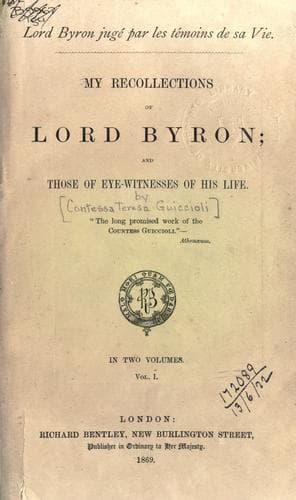
My Recollections of Lord ByronGuiccioli, Teresa, contessa di
General
My Recollections of Lord Byron
Guiccioli, Teresa, contessa di
Byron, George Gordon Byron, Baron, 1788-1824; Poets, English -- 19th century -- Biography
This sympathy, however, would never have found a place in the mind of
Lord Byron had it not sprung from his heart. Amiability was essential in
his friends before he could love them; and though Moore had not that
quality in its highest degree, still he had it sufficiently for Lord
Byron to say in one of his notes, "I have received the most amiable
letter possible from Moore. I really think him the most kind-hearted man
I ever met. Besides which, his talents are equal to his sentiments."
His sympathy for Moore was such that the mention of his name was enough
to awaken his spirits and give him joy. This is palpable in his letters
to Moore, which are masterpieces of talent.
His cordial friendship for Moore was never once affected by the series
of triumphs which followed its formation, and which made the whole world
bow before his genius. "The new scenes which opened before him with his
successes," says Moore, "far from detaching us from one another,
multiplied, on the contrary, the opportunities of meeting each other,
and thereby strengthening our intimacy."
This excessive liking for Moore was kept up by all the force which
constancy lends to affection. One of Byron's most remarkable qualities
was great constancy in his likes, tastes, and a particular attachment to
the recollections of his childhood. At the age of fifteen, Moore's
"Melodies" already delighted him. "I have just been looking over Little
Moore's Melodies, which I knew by heart at fifteen." In 1803 he wrote
from Ravenna: "Hum! I really believe that all the bad things I ever
wrote or did are attributable to that rascally book."
We have seen that at Southwell he used even to ask Miss Chaworth and
Miss Pigott to sing him songs of Moore. At Cambridge, what reconciled
him to leaving Harrow were the hours which he spent with his beloved
Edward Long, with whom he used to read Moore's poetry after having
listened to Long's music.
He already then had a sympathy for Moore, and a wish to know him. The
latter's place was therefore already marked out in Byron's heart, even
before he was fortunate enough to know him.
Moore's straitened means often obliged him to leave London. Then Byron
was seized with a fit of melancholy.
"I might be sentimental to-day, but I won't," he said. "The truth is
that I have done all I can since I am in this world to harden my heart,
and have not yet succeeded, though there is a good chance of my doing
so.
"I wish your line and mine were a little less parallel, they might
occasionally meet, which they do not now.
"I am sometimes inclined to write that I am ill, so as to see you arrive
in London, where no one was ever so happy to see you as I am, and where
there is no one I would sooner seek consolation from, were I ill."
Public-domain text, read in full here on John Shaqi.
Reviews
Reviews
No reviews yet
Be the first to share your thoughts on this work.
Elsewhere in the archive
Join the Discussion
Join the discussion
Sign in to leave a comment or review.
Sign InorCreate an account