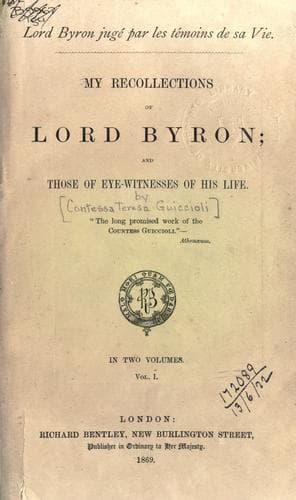
My Recollections of Lord ByronGuiccioli, Teresa, contessa di
General
My Recollections of Lord Byron
Guiccioli, Teresa, contessa di
Byron, George Gordon Byron, Baron, 1788-1824; Poets, English -- 19th century -- Biography
"Is it true what Shelley writes me, that poor John Keats died at Rome of
the 'Quarterly Review?' I am very sorry for it; though I think he took
the wrong line as a poet, and was spoilt by Cockneyfying and suburbing,
and versifying Tooke's 'Pantheon' and Lempriere's 'Dictionary.' I know
by experience, that a savage review is hemlock to a sucking author; and
the one on me (which produced the 'English Bards,' etc.) knocked me
down; but I got up again. Instead of bursting a bloodvessel, I drank
three bottles of claret, and began an answer, finding that there was
nothing in the article for which I could lawfully knock Jeffrey on the
head, in an honorable way. However, I would not be the person who wrote
the homicidal article for all the honor and glory in the world, though I
by no means approve of that school of scribbling which it treats upon."
Some time after he wrote again to Murray, saying,--"You know very well
that I did not approve of Keats's poetry, nor of his poetical
principles, nor of his abuse of Pope. But he is dead. I beg that you
will therefore omit all I have said of him either in my manuscripts or
in my publications. His 'Hyperion' is a fine monument, and will cause
his name to last. I do not envy the man who wrote the article against
Keats."
Several months later he made complete amends. He added to his severe
article in answer to Blackwood, a note in the following terms:
"I have read the article before and since; and although it is bitter, I
do not think that a man should permit himself to be killed by it. But a
young man little dreams what he must inevitably encounter in the course
of a life ambitious of public notice. My indignation at Mr. Keats's
depreciation of Pope has hardly permitted me do justice to his own
genius, which, _malgre_ all the fantastic fopperies of his style, was
undoubtedly of great promise. His fragment of 'Hyperion' seems actually
inspired by the Titans, and is as sublime as AEschylus. He is a loss to
our literature; and the more so, as he himself, before his death, is
said to have been persuaded that he had not taken the right line, and
was reforming his style upon the more classical models of the language."
Were we wrong in saying that the accusations against Byron, with respect
to Keats, did not deserve a notice? If we have noticed them, it has been
merely to show, that the French critic should have judged matters in
this instance with greater conscientiousness and reflection.
Influenced as Byron always was by his own ideas of beauty, he required
in the authors themselves certain moral qualities which would demand for
their works the bestowal of his praise. It was not only their talent,
but their loyalty, their independence of character, their political
consistency, and their perfect honesty, which endeared Walter Scott,
Moore, and others, to him.
Public-domain text, read in full here on John Shaqi.
Reviews
Reviews
No reviews yet
Be the first to share your thoughts on this work.
Elsewhere in the archive
Join the Discussion
Join the discussion
Sign in to leave a comment or review.
Sign InorCreate an account