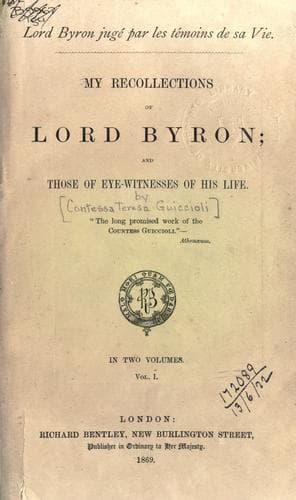
My Recollections of Lord ByronGuiccioli, Teresa, contessa di
General
My Recollections of Lord Byron
Guiccioli, Teresa, contessa di
Byron, George Gordon Byron, Baron, 1788-1824; Poets, English -- 19th century -- Biography
Moore tells us that Byron was so keenly sensitive to the pleasure or
pain of those with whom he lived, that while in his imaginary realms he
defied the universe, in real life a frown or a smile could overcome him.
Proud, energetic, independent, intrepid, benevolence alone rendered Lord
Byron so flexible, patient, and docile to the remonstrances or
reproaches of those who loved him, and to whom he allowed friendly
motives, that he often sacrificed his own talent to this genial and
kindly sentiment. The Rev. Mr. Beecher, disapproving as too free one of
the poems he had just published at the age of seventeen, in his first
edition of the "Hours of Idleness," Lord Byron _withdrew_ and _burnt_
the whole edition. At the solicitation of Dallas and Gifford he
suppresses, in the second canto of "Childe Harold," the very stanzas he
preferred to all the rest. Madame G----, grieved at the persecution
drawn down on him by the first canto of "Don Juan," begs him to
discontinue the poem, and he ceased to write it.
At the request of Madame de Stael, he consented, in spite of his great
disinclination, to attempt a reconciliation with Lady Byron.
The "Curse of Minerva," a poem written in Greece, while he was still
painfully impressed by the artistic piracies of Lord Elgin in the
"Parthenon," was in the press and on the eve of publication; but Lord
Elgin's friends reminded him of the pain it would inflict on him and on
his family, and the poem was sacrificed. No one ever bore more
generously than he with reproaches made with good-will and kindness.
This amiable disposition, observed in Greece by Mr. Finlay, led him to
say that it amazed him. As regards Lord Byron's tenderness toward his
friends, it was always so great and constant, that we have thought it
right to devote a long article to it. We will, however, quote as another
instance of the delicacy of his friendship and his fear of offending his
friends, or of giving them pain, a letter which Moore also cites as a
proof of his extreme sensitiveness in this respect.
This letter was addressed to Mr. Bankes, his friend and college
companion, on one occasion when Byron believed he had offended him
involuntarily:--
"MY DEAR BANKES,--My eagerness to come to an explanation has, I trust,
convinced you that whatever my unlucky manner might inadvertently be,
the change was as unintentional as (if intended) it would have been
ungrateful. I really was not aware that, while we were together, I had
evinced such caprice. That we were not so much in each other's company
as I could have wished, I well know; but I think so astute an observer
as yourself must have perceived enough to explain this, without
supposing any slight to one in whose society I have pride and pleasure.
Recollect that I do not allude here to 'extended' or 'extending'
acquaintances, but to circumstances you will understand, I think, on a
little reflection.
Public-domain text, read in full here on John Shaqi.
Reviews
Reviews
No reviews yet
Be the first to share your thoughts on this work.
Elsewhere in the archive
Join the Discussion
Join the discussion
Sign in to leave a comment or review.
Sign InorCreate an account