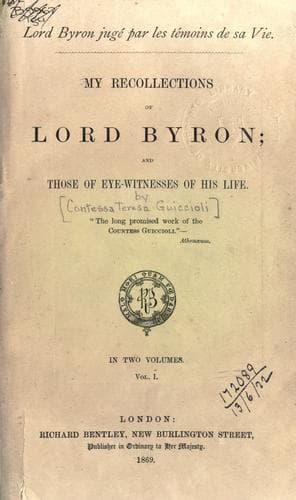
My Recollections of Lord ByronGuiccioli, Teresa, contessa di
General
My Recollections of Lord Byron
Guiccioli, Teresa, contessa di
Byron, George Gordon Byron, Baron, 1788-1824; Poets, English -- 19th century -- Biography
"And angling, too, that solitary vice,
Whatever Izaak Walton sings or says:
The quaint, old, cruel coxcomb, in his gullet
Should have a hook, and a small trout to pull it."
And, as if he feared not to have expressed strongly enough his aversion
for the cruelties of angling, he adds in a note:--
"It would have taught him humanity at least. This sentimental savage,
whom it is a mode to quote (among the novelists) to show their sympathy
for innocent sports and old songs, teaches how to sew up frogs, and
break their legs by way of experiment, in addition to the art of
angling,--the cruelest, the coldest, and the stupidest of pretended
sports. They may talk about the beauties of nature, but the angler
merely thinks of his dish of fish; he has no leisure to take his eyes
from off the streams, and a single bite is worth to him more than all
the scenery around. Besides, some fish bite best on a rainy day. The
whale, the shark, and the tunny fishery have somewhat of noble and
perilous in them; even net-fishing, trawling, etc., are more humane and
useful. But angling!--no angler can be a good man."
"One of the best men I ever knew (as humane, delicate-minded, generous,
and excellent a creature as any in the world) was an angler; true, he
angled with painted flies, and would have been incapable of the
extravagances of Izaak Walton."
"The above addition was made by a friend, in reading over the
MS.:--'_Audi alteram partem_'--I leave it to counterbalance my own
observations."
It is well known that Lord Byron would not deride certain superstitions,
and was sometimes tempted to exclaim with Hamlet,--
"There are more things in Heaven and earth, Horatio,
Than are dreamt of in your philosophy."
He, consequently, also conformed to the English superstition, which
involves, under pain of an unlucky year, the eating of a goose at
Michaelmas. Alas! once only he did not eat one, and that year was his
last; but he eat none because, during the journey from Pisa to Genoa, on
Michaelmas eve, he saw the two white geese in their cage in the wagon
that followed his carriage, and felt so sorry for them that he gave
orders they should be spared. After his arrival at Genoa they became
such pets that he caressed them constantly. When he left for Greece he
recommended them to the care of Mr. Kennedy, who was probably kind to
them for the sake of their illustrious protector.
Not only could Lord Byron never contribute voluntarily to the suffering
of a living being, but his pity, his commiseration for the sufferings of
his fellow-creatures showed itself all his life in such habitual
benevolence, in such boundless generosity, that volumes would be
necessary to record his noble deeds.
Public-domain text, read in full here on John Shaqi.
Reviews
Reviews
No reviews yet
Be the first to share your thoughts on this work.
Elsewhere in the archive
Join the Discussion
Join the discussion
Sign in to leave a comment or review.
Sign InorCreate an account