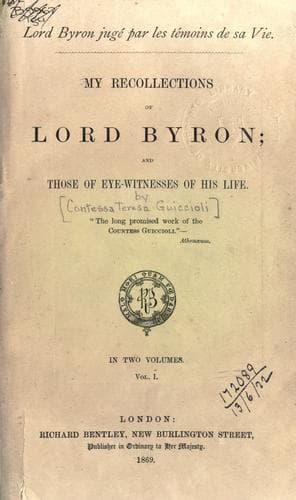
My Recollections of Lord ByronGuiccioli, Teresa, contessa di
General
My Recollections of Lord Byron
Guiccioli, Teresa, contessa di
Byron, George Gordon Byron, Baron, 1788-1824; Poets, English -- 19th century -- Biography
Who better than Moore knew that Byron was not irreligious?--And yet he
pretended that he was. And finally, Who was better aware that Byron's
greatest aim was to be useful to humanity, and yet encouraged the belief
that Byron's expedition to Greece was purely to satisfy the desire that
people should speak of him as a superior man? In a few words, Moore has
not made the best of Byron's qualities, has kept silence over many
things which might have enhanced his character in public opinion; and
wished, above all, to show the greatness of his poetical genius, which
was never questioned. One would almost say that Moore did not like Byron
to be too well spoken of: for whenever he praises, he ever accompanies
the praise with a blame, a "but" or an "if;" and instead of openly
contradicting accusations which he knew to be false, and honestly
proclaiming the truth, he, too, preferred to excuse the poet's supposed
shortcomings. Moore was wanting in courage. He was good, amiable, and
clever; but weak, poor, and a lover of rank--where, naturally, he met
with many political enemies of Byron. He, therefore, dared not then tell
the truth, having too many interests to consider. Hence his concessions
and his sluggishness in leaving the facts as they were; and in many
cases, when it was a question between the departed Byron and one of his
high detractors, the one sacrificed was the dead friend who could no
longer defend himself. All such considerations for the living were
wrongs toward the memory of Byron.
The gravest accusation, however, to which Moore is open is, that he did
not preserve the Memoirs which Byron gave him on the sworn condition
that nothing should prevent their publication. The promise thus given
had restored peace to Byron's mind, so confident was he that it would be
fulfilled. To have broken his word is a crime for which posterity will
never forgive Moore. Can it be alleged, by way of excuse, that he gave
extracts from it? But besides the authenticity of the extracts, which
might be questioned, of what value can be a composition like Moore's in
presence of Byron's very words? No one can pretend to be identified with
such a mind as Byron's in the expression of his own feelings; and, least
of all, a character like Moore's.
The "Memoirs," then, which were the justification of Byron's life; the
last cantos, which were the justification of the poet and of the man;
the journal, which showed his prudence and sagacity beyond his age,
which by the simple relation of facts proved how he had got rid of all
the imperfections of youth, and at last become the follower of wisdom,
so much so that he would have been one of the most virtuous men in
England--all have been lost to the world: they have descended with him
into the tomb, and thus made room for the malice of his detractors.
Hence the duty of not remaining silent on the subject of this
highly-gifted man.
Public-domain text, read in full here on John Shaqi.
Reviews
Reviews
No reviews yet
Be the first to share your thoughts on this work.
Join the Discussion
Join the discussion
Sign in to leave a comment or review.
Sign InorCreate an account