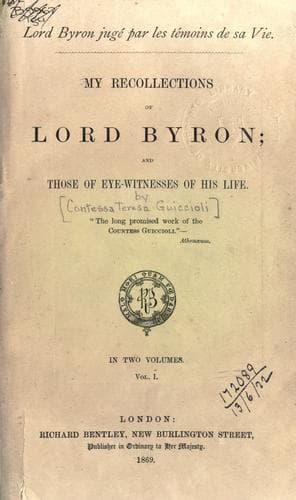
My Recollections of Lord ByronGuiccioli, Teresa, contessa di
General
My Recollections of Lord Byron
Guiccioli, Teresa, contessa di
Byron, George Gordon Byron, Baron, 1788-1824; Poets, English -- 19th century -- Biography
In publishing these pages, written conscientiously and scrupulously, we
confide in the opinion expressed above in the magic language of the man
who can create any prestige. If the reader finds these guarantees of
truth sufficient, and deigns to accept our conscientious remarks with
indulgence and kindness; if, after examining Byron's character under all
its aspects, after repeating his words, recalling his acts, and speaking
of his life--especially of that which he led in Italy--and mentioning
the various impressions which he produced upon those who knew him
personally, we are justified in the reader's opinion in having
endeavored to clear the reality from all the clouds which imagination
has gathered round the person of Byron, and in trying to earn for his
memory a little sympathy by proclaiming the truth, in place of the
antipathy which falsehood has hitherto obtained for him, our object will
have been obtained.
To endeavor to restore Byron's reputation is the more necessary, since
Moore himself, who is his best biographer, failed not only in his duty
as a friend, but as the historian of the poet's life: for he knew the
truth, and dared not proclaim it. Who, for instance, could better inform
us of the cause which led to Byron's separation from his wife? And yet
Moore chose to keep the matter secret.
Who was better acquainted with the conduct of Byron's colleagues at the
time of his conjugal differences--with the curious proposals which were
made to him by them to recover their good graces--with his refusal to
regain them at such a cost--with the persecution to which he was, after
that, subjected--with the names of the people who instigated a popular
demonstration against him--with all the bad treatment which obliged him
to quit England? And yet has Moore spoken of it?[4]
Who, better than Moore, could tell of the friends on whom Byron relied,
and who at the time of his divorce sided with Lady Byron, and even went
so far as to aggravate the case by falsely publishing reports of his
having ill-treated Lady Byron and discharged loaded guns in order to
frighten her?
Who was better acquainted with the fact that the last cantos of "Don
Juan," written in Greece, had been destroyed in England, and that the
journal which he kept after his departure from Genoa had been destroyed
in Greece? Moore knew it very well, and did not reveal these facts, lest
he should create enemies for himself. He actually went so far as to
pretend that Byron never wrote any thing in Greece.[5]
Public-domain text, read in full here on John Shaqi.
Reviews
Reviews
No reviews yet
Be the first to share your thoughts on this work.
Join the Discussion
Join the discussion
Sign in to leave a comment or review.
Sign InorCreate an account