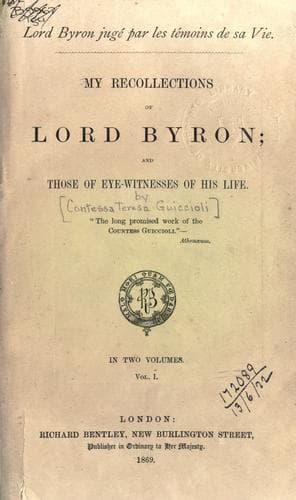
My Recollections of Lord ByronGuiccioli, Teresa, contessa di
General
My Recollections of Lord Byron
Guiccioli, Teresa, contessa di
Byron, George Gordon Byron, Baron, 1788-1824; Poets, English -- 19th century -- Biography
Lord Byron had also kept a journal since the day of his departure from
Genoa up to the time when illness made the pen drop from his hand. To it
he had consigned his most intimate thoughts; and we may well imagine how
full of interest it must have been, written amid all the emotions
agitating his soul at that time. This journal was found among his papers
by a personage of high standing in Greece, who was the first to inspect
them, and who, seeing his own name and conduct mentioned in no
flattering terms, destroyed them in order to hide from England the
unvarnished truth told of himself. Count Gamba often speaks of this
journal in the letters addressed at this period to his sister.
We leave the reader to make his own comments on these too regrettable
facts.]
CHAPTER I.
LORD BYRON AND M. DE LAMARTINE.
_To Count de_ ----.
Paris, 17th June, 1860.
MY DEAR COUNT,--Confiding in your willingness to oblige, I beg to ask a
favor and your advice. I received, a short time ago, a prospectus of a
subscription to be raised for a general addition of the works of M. de
Lamartine. You are aware that when it is a question of showing my
sympathy for M. de Lamartine I would never miss the opportunity of doing
so; but on this occasion I see on the programme the promise of a Life of
Lord Byron. Such an announcement must alarm the friends of that great
man; for they remember too vividly the sixteenth number of the "Cours
Litteraire" to subscribe hastily to a work when they have not more
information than is therein given. You, who forget nothing, must
probably remember the strange judgment of Byron formed by M. de
Lamartine in that article. Identifying the man with the poet, and
associating his great name with that of Heine on account of some rather
hazardous lines in "Don Juan," and forgetting the license allowed to
such poetry--an imitation of the Italian poets Berni, Ariosto, Pulci,
Buratti--M. de Lamartine did not forget a few personal attacks upon
himself, and called Byron the founder of the school for promoting
satanic laughter, while he heaped upon him the most monstrous
accusations. M. de Lamartine ventured to say of Byron things which even
his greatest enemies never dared to utter at that time when in England
it was the custom to revile him. Although the time has not yet come when
Lord Byron's life should be written, since the true sources of
collecting information respecting him are unattainable so long as the
people live to whom his letters were addressed, still it is easy to
perceive that the time has at length arrived when in England the desire
to do him justice and fairly to examine his merits is felt by the nation
generally. Moore, Parry, Medwin, etc., have already attempted to make
known the character of the man as distinct from that of the poet. They
no longer sought to find in him a resemblance with Childe Harold, or the
Corsair, or Manfred, or Don Juan, nor to judge of him by the
Public-domain text, read in full here on John Shaqi.
Reviews
Reviews
No reviews yet
Be the first to share your thoughts on this work.
Join the Discussion
Join the discussion
Sign in to leave a comment or review.
Sign InorCreate an account