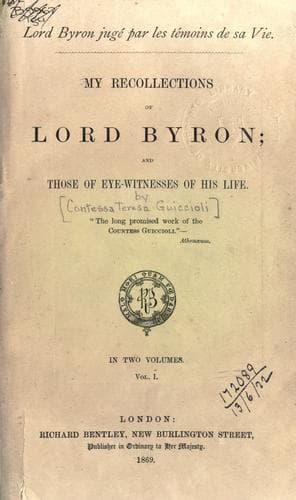
My Recollections of Lord ByronGuiccioli, Teresa, contessa di
General
My Recollections of Lord Byron
Guiccioli, Teresa, contessa di
Byron, George Gordon Byron, Baron, 1788-1824; Poets, English -- 19th century -- Biography
conversations in which he sought to mystify those with whom he
conversed; but they judged him by his acts and by his correspondence.
If so happy a reaction, however, is visible in England the same can not
be said of France, where there being no time to read what is published
elsewhere, an error is too soon embraced and ingrafted on the mind of
the public as a consequence of a certain method which dispenses with all
research. Hence the imaginary creation which has been called Byron, and
which has been maintained in France notwithstanding its being wholly
unacceptable as a portrait of the man, and totally different from the
Byron known personally to some happy few who had the pleasure of
beholding in him the handsomest, the most amiable of men, and the
greatest genius whom God has created.
But M. de Lamartine, who wishes particularly to show the character of
the man, instead of adding to the numerous proofs of courage and
grandeur of mind which he has personally shown to the world--that of
confessing that he has erred in his judgment of Byron--endeavors to
study him only in his works. But in doing this, and even though a moral
object may be found in each of Byron's works, it strikes us that M. de
Lamartine would have done better to pursue this line in the analysis of
the intellectual part of the man, and not the moral side.
"You err" (wrote Byron to Moore on the occasion of the latter saying
that such a poem as the "Vision of Judgment" could not have been written
in a desponding mood): "a man's poetry is a distinct faculty or soul,
and has no more to do with the every-day individual than the inspiration
of the Pythoness when removed from her tripod." To which Moore observes:
"My remark has been hasty and inconsiderate, and Lord Byron's is the
view borne out by all experience. Almost all the tragic and gloomy
writers have been, in social life, mirthful persons. The author of the
'Night Thoughts' was a fellow of infinite jest; and of the pathetic
Otway, Pope says, 'He! why, he would laugh all the day long; he would do
nothing but laugh!'"
Public-domain text, read in full here on John Shaqi.
Reviews
Reviews
No reviews yet
Be the first to share your thoughts on this work.
Join the Discussion
Join the discussion
Sign in to leave a comment or review.
Sign InorCreate an account