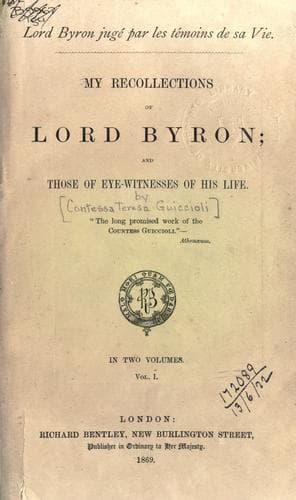
My Recollections of Lord ByronGuiccioli, Teresa, contessa di
General
My Recollections of Lord Byron
Guiccioli, Teresa, contessa di
Byron, George Gordon Byron, Baron, 1788-1824; Poets, English -- 19th century -- Biography
Madame de Stael had a great affection for Lord Byron, but his detractors
had found their way into her house.[13] Among these was a distinguished
lawyer, who had never been injured by any speech or word of Lord Byron,
but who, setting himself up as an amateur enemy of the poet, had, under
an anonymous designation, been one of his bitterest detractors in the
"Edinburgh Review," on the occasion of the publication of his early
poems. This same lawyer endeavored to gain Madame de Stael over to his
opinion of Byron's merit, probably on account of the very knowledge that
he had of the harm he had done him; hatred, like nobility, has its
obligations. But Madame de Stael, who, on reading "Farewell," was wont
to say that she wished almost she had been as unfortunate as Lady Byron,
was too elevated in mind and too noble in character to listen quietly to
the abuse of Byron in which his enemies indulged. She, however, tried to
induce Lord Byron to become reconciled to his wife, on the ground that
one should never struggle against the current of public opinion. Madame
de Stael actually succeeded in obtaining his permission to endeavor to
effect this reconciliation; but the lawyer before mentioned used every
argument to prevent her pursuing this project of mediation.
Lord Byron's biographers have told how Lady Byron received this
proposal; which, after the way in which he had been treated, appears to
have been, on the part of Byron, an act of almost superhuman generosity.
Such an offer should have moved any being gifted with a heart and a
soul. But I will not here speak of her refusal and of its consequences;
all I wish to state is, that the calumnies put forward against him being
too absurd for Byron to condescend to notice, assumed a degree of
consistency which deceived the public, and even made dupes of superior
men, who in their turn contributed to make dupes of others. At this
time, then, when the war and the continental blockade were at an end,
when each and every one came pouring on to the Continent, did the star
of Byron begin to shine on the European horizon; but, instead of
appearing as a sublime and bountiful star, it appeared surrounded by
dark and ominous clouds.
Lamartine, who was then travelling in Switzerland, was able to find in
this sad state of things materials for his fine poem "Meditation," and
for doubts whether Byron was "an angel, or a demon," according to the
manner in which he was viewed, be it as a poet or as a man; and, as if
all this were not enough, a host of bad writings were attributed to his
pen, which brought forth the following expressions in a letter to
Murray, his publisher:--
Public-domain text, read in full here on John Shaqi.
Reviews
Reviews
No reviews yet
Be the first to share your thoughts on this work.
Elsewhere in the archive
Join the Discussion
Join the discussion
Sign in to leave a comment or review.
Sign InorCreate an account