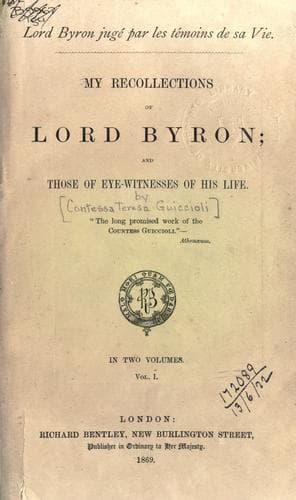
My Recollections of Lord ByronGuiccioli, Teresa, contessa di
General
My Recollections of Lord Byron
Guiccioli, Teresa, contessa di
Byron, George Gordon Byron, Baron, 1788-1824; Poets, English -- 19th century -- Biography
"I had hoped that some other lie would have replaced and succeeded to
the thousand and one falsehoods amassed during the winter. I can forgive
all that is said of or against me, but not what I am made to say or sing
under my own name. I have quite enough to answer for my own writings. It
would be too much even for Job to bear what he has not said. I believe
that the Arabian patriarch, when he wished his enemies had written a
book, did not go so far as to be willing to sign his name on the first
page."
But the public mind was so disposed to look at Byron in the light of a
demon, as traced by Lamartine, that when some young scattered-brain
youth published out of vanity, or perhaps for speculative motives,
another monstrous invention, in the hope of passing it off as a work of
Byron, he actually succeeded for some time in his object without being
discovered.
"Strange destiny both of books and their authors!" exclaims the writer
of the "Essai sur Lord Byron," published in 1823,--"an evidently
apocryphal production, which was at once seen not to be genuine by all
persons of taste, notwithstanding the forgery of the title, has
contributed as much to make Byron known in France as have his best
poems. A certain P---- had impudence enough to attribute indirectly to
the noble lord himself the absurd and disgusting tale of the 'Vampire,'
which Galignani, in Paris, hastened to publish as an acknowledged work
of Byron. Upon this Lord Byron hastened to remonstrate with Messieurs
Galignani; but unfortunately too late, and after the reputation of the
book was already widespread. Our theatres appropriated the subject, and
the story of Lord Ruthven swelled into two volumes which created some
sensation."[14]
Goethe also believed the novels to be true stories, and was especially
impressed with "Glenarvon."[15] It is reported that he became jealous
of Byron on the appearance of the poem of "Manfred." If he were not, it
is at least certain that the pagan patriarch never could sympathize with
the new generation of Christian geniuses.
On the 7th of June, however, of the year 1820, Byron writes as follows
to Murray, from Ravenna:--
Public-domain text, read in full here on John Shaqi.
Reviews
Reviews
No reviews yet
Be the first to share your thoughts on this work.
Elsewhere in the archive
Join the Discussion
Join the discussion
Sign in to leave a comment or review.
Sign InorCreate an account