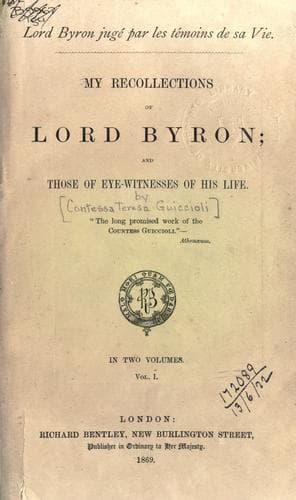
My Recollections of Lord ByronGuiccioli, Teresa, contessa di
General
My Recollections of Lord Byron
Guiccioli, Teresa, contessa di
Byron, George Gordon Byron, Baron, 1788-1824; Poets, English -- 19th century -- Biography
We have elsewhere described the various phases of this phenomenon, one
of the principal causes of which has been the resolution to identify the
poet with the first heroes of his poems. Such a mode of proceeding was
as disloyal as it was contrary to all the received rules of literature.
It was inspired by hatred and vengeance, adopted by an idle and
frivolous public, and the result has proved to be something entirely
opposed to the truth.
As long as such a whimsical creation was harmless, it amused Byron
himself and his friends; but the day came when it ceased to be harmless
without ceasing to be eccentric, and became to Byron a true robe of
Nessus.
At his death the truth was demanded of his biographers; but the puppet
which had been erected stood there, and amazed the good, while it served
the malice of the wicked. His genius was analyzed, but no conscientious
study of his character was made, and Byron, as man, remained an unknown
personage.
Yet among his biographers there were men of upright and enlightened
minds: they did not all seek to raise themselves at the cost of
depreciating him, nor to gain popularity by sparing individuals at the
expense of Lord Byron.
If among them many proved to be black sheep, there were several, on the
other hand, who were sincere, and even kindly disposed. Yet not one did
full justice to Byron, not one defended him as he deserved, not one
explained his true character with the conscientious energy which in
itself constitutes authority. We shall speak elsewhere of the causes
which gave rise to this phenomenon. We shall mention the part which
public opinion played in England when suddenly displeased with a poet
who dared sound the deepest recesses of the human heart; and who as an
artist and a psychologist was interested in watching the growth of every
passion, and especially that of love, regardless of the conjugal
felicity which that public wished him to respect. It began to fear that
its enthusiasm for Lord Byron was a national crime, and by degrees
became accessory to the calumnies which were heaped upon his noble
character, on account of his supposed want of patriotism, and his
refusal to be blind to the defects of the mother-country. We shall see
how his biographers, preferring invention to strict adherence to the
truth, compounded a Lord Byron such as not to be any longer
recognizable, and to become even--especially in France--a caricature. Of
all this we shall speak hereafter. We shall now rather point to the
curious than to the unjust character of this fact, and notice the
contradictions to which Byron's biographers have lent themselves.
Public-domain text, read in full here on John Shaqi.
Reviews
Reviews
No reviews yet
Be the first to share your thoughts on this work.
Join the Discussion
Join the discussion
Sign in to leave a comment or review.
Sign InorCreate an account