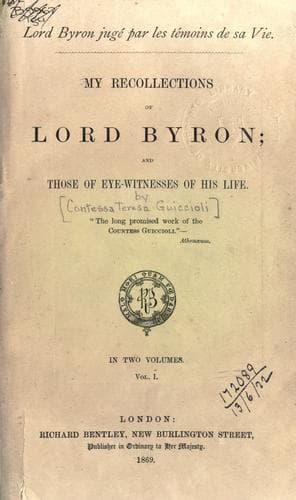
My Recollections of Lord ByronGuiccioli, Teresa, contessa di
General
My Recollections of Lord Byron
Guiccioli, Teresa, contessa di
Byron, George Gordon Byron, Baron, 1788-1824; Poets, English -- 19th century -- Biography
All, or nearly all, have granted to him an infinity of virtues, and
naturally fine qualities--such as sensitiveness, generosity, frankness,
humility, charity, soberness, greatness of soul, force of wit, manly
pride, and nobility of sentiment; but, at the same time, they do not
sufficiently clear him of the faults which directly exclude the
above-mentioned qualities. The moral man does not sufficiently appear in
their writings: they do not sufficiently proclaim his character--one of
the finest that was ever allied to a great intellect. Why? Are these
virtues such that, like excellent and salutary substances, they become
poisoned when placed in contact within the same crucible?
In this refusal to do justice there is contradiction; and as error
exists where contradiction lies, it is precisely in that contradiction
that we must seek the means of refuting error and assert the power of
truth.
Nature always proceeds logically, and the effect is always in direct
analogy with its cause. Even in the moral world the precise character of
exact sciences must be found. If in a problem we meet with a
contradiction, are we not certain that its solution has been badly
worked out, and that we must begin it over again to find a true result?
The same reasoning holds good for the moral spheres. When a judgment has
been wrongly formed, that is, when there appears to be contradiction
between various opinions, that judgment must be remodelled, the cause of
the error must be looked for, truth must be separated from falsehood,
and regard must be had to the law which obliges us to weigh impartially
every assertion, and to discuss equally the ayes and noes. Let this be
done for Lord Byron. Let us analyze facts, question the eye-witnesses of
his life, and peruse his admirable and simply-written letters, wherein
his soul has, so to say, photographed itself. Acts are unquestionably
more significative than words; yet if we wish to inquire into his
poetry, not by way of appreciating his genius (with which at present we
have nothing to do), but the nature of the man, let us do so loyally.
Let us not attribute to him the character which he lends to his heroes,
nor the customs which he attributes to them, simply because here and
there he has given to the one something of his manner, to the other some
of his sentiments; or because he has harbored them, in the belief that
hospitality can be extended to the wicked without the good suffering
from it.
Let us first examine "Childe Harold,"--the poem which principally
contributed to mystify the public, and commenced that despotic type of
which we have already spoken.
Public-domain text, read in full here on John Shaqi.
Reviews
Reviews
No reviews yet
Be the first to share your thoughts on this work.
Join the Discussion
Join the discussion
Sign in to leave a comment or review.
Sign InorCreate an account