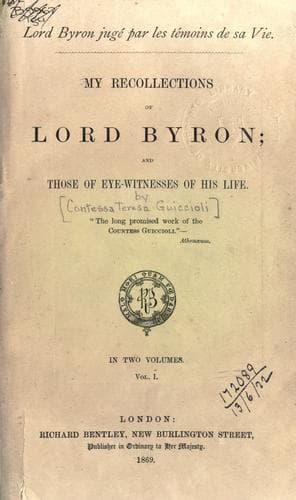
My Recollections of Lord ByronGuiccioli, Teresa, contessa di
General
My Recollections of Lord Byron
Guiccioli, Teresa, contessa di
Byron, George Gordon Byron, Baron, 1788-1824; Poets, English -- 19th century -- Biography
disease of his mind, Childe Harold, _disgusted with the sins of his
youth_, no longer seeks the road to virtue, but begins to experience
with Solomon the vanity of human things, becomes a prey to satiety,
ennui, and to insensibility to both physical and moral worth.
Byron, who made the intellectual education of his day responsible for
Childe Harold's faults, had conceived this character in his earliest
days at Harrow. It was in any case, he said, a characteristic of the
youth of those days, although idealized and drawn from his own
imagination. His enemies and his rivals have endeavored to prove that
he wished to describe in this poem the state of his own mind. They made
capital out of a few historical and local circumstances, to give to
their falsehood some appearance of truth. But only those who did not
know him personally could be ignorant how improbable it was that any
resemblance between the poet and his hero could be maintained.
Let us confine ourselves to the remark that Lord Byron, instead of
personifying his hero, personifies no one but simply the poet. Let us
add, besides, that in no case could Lord Byron be made responsible for
the consequences of the doctrines of the materialists, as held by his
hero. Not only because of his nature, which was totally opposed to them,
but also and especially because of his tendencies, which were eminently
and persistently those of a spiritualist, and which clung to him
throughout his life even at the time when he was accused of skepticism.
This was at the time when he wrote the second canto of "Childe Harold."
Thoughts, little in unison with, if not entirely opposed to his intimate
convictions, sprang from his sick heart to his head: his soul became
dejected, and his copious tears so obscured his eyes as to veil from
them for a time the existence of the Almighty, which he seemed to
question; and he appeared to think that if the Cambridge philosophy was
right in doubting the soul's spirituality, its immortality might be
equally questioned. These doubts having been expressed in his own, and
not in his hero's name, at the outset of the second canto of "Childe
Harold," led to his being also accused of skepticism.
Public-domain text, read in full here on John Shaqi.
Reviews
Reviews
No reviews yet
Be the first to share your thoughts on this work.
Elsewhere in the archive
Join the Discussion
Join the discussion
Sign in to leave a comment or review.
Sign InorCreate an account