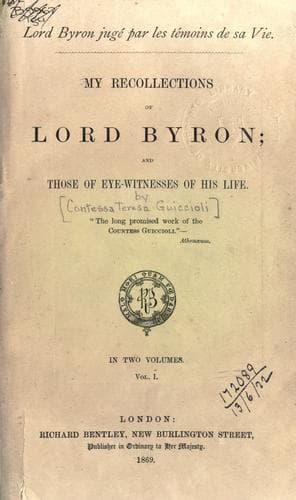
My Recollections of Lord ByronGuiccioli, Teresa, contessa di
General
My Recollections of Lord Byron
Guiccioli, Teresa, contessa di
Byron, George Gordon Byron, Baron, 1788-1824; Poets, English -- 19th century -- Biography
But if pain actually paralyzed for a time the elasticity of his mind,
the latter very soon recovered its natural vigor and showed itself in
all its glowing energy in the eighth and ninth stanzas, which are most
delicate emanations from a beautiful soul. The first stanzas alone,
however, continued to occupy the attention of some orthodox and
over-scrupulous minds: poetry not necessarily being a mode of teaching
philosophy. We must besides remark that the meaning of the lines is
purely hypothetical. In _saying_ that the soul might _not be immortal_,
is it not saying much the same as was said by Locke in the words _the
soul is perhaps spiritual_? Is not that perishable which is capable of
dissolution according to the laws of the world? Lord Byron, though a
stanch spiritualist at heart, derived his doubts from other much less
exalted authorities. Believing implicitly in the omnipotence of the
Creator, could he not modestly fear that God, who had made his soul out
of nothing, might cause it to return to nothing? Might he not imagine
that the contrary belief was rather the result of our wishes, of our
pride, and of the importance which we love to attach to ourselves? Can
the conviction of the existence of immortality, unless founded upon
revelation, be any thing else but a hope or a sentiment? Pantheists
alone find immortality to be the fatal consequence of their presumptuous
doctrine. But what an immortality! One to be laughed at, as a
philosopher of our days so well expresses it.
Accused of skepticism, Byron replied by explaining the meaning of his
lines in a note which, at the instance of Mr. Dallas, he also consented
to suppress with his habitual good-nature, and in which he endeavored to
show that the spirit which pervaded the whole of the poem was rather one
of discouragement and despair, than raillery at religion, and that,
after all, the effect of religion upon the world had been less to make
men love their equals than to excite the various sects to a hatred
against one another, and thus give rise to those fanatical wars which
have caused so much bloodshed and injured so deeply the cause which they
were intended to defend.
In reading this note again, one can with difficulty make out what
Dallas's objections were, and why he tried so hard to have it
suppressed; for it savors much more of a spirit of toleration and
charity than of skepticism. Lord Byron nevertheless withdrew it.
But this was not enough to satisfy the British straight-lacedness. As
the accusations against his skepticism were on the increase daily, Mr.
Gifford, for whose enlightened opinion Byron ever had great respect,
advised him to be more prudent, whereupon Byron replied:--
Public-domain text, read in full here on John Shaqi.
Reviews
Reviews
No reviews yet
Be the first to share your thoughts on this work.
Elsewhere in the archive
Join the Discussion
Join the discussion
Sign in to leave a comment or review.
Sign InorCreate an account