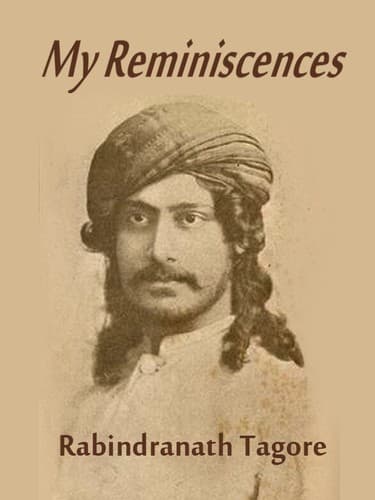
Authors, Bengali -- 20th century -- Biography; Tagore, Rabindranath, 1861-1941
When, after his long absences, my father came home even for a few days,
the whole house seemed filled with the weight of his presence. We would
see our elders at certain hours, formally robed in their _chogas_,
passing to his rooms with restrained gait and sobered mien, casting away
any _pan_[20] they might have been chewing. Everyone seemed on the
alert. To make sure of nothing going wrong, my mother would superintend
the cooking herself. The old mace-bearer, Kinu, with his white livery
and crested turban, on guard at my father's door, would warn us not to
be boisterous in the verandah in front of his rooms during his midday
siesta. We had to walk past quietly, talking in whispers, and dared not
even take a peep inside.
On one occasion my father came home to invest the three of us with the
sacred thread. With the help of Pandit Vedantavagish he had collected
the old Vedic rites for the purpose. For days together we were taught to
chant in correct accents the selections from the Upanishads, arranged by
my father under the name of "Brahma Dharma," seated in the prayer hall
with Becharam Babu. Finally, with shaven heads and gold rings in our
ears, we three budding Brahmins went into a three-days' retreat in a
portion of the third storey.
It was great fun. The earrings gave us a good handle to pull each
other's ears with. We found a little drum lying in one of the rooms;
taking this we would stand out in the verandah, and, when we caught
sight of any servant passing alone in the storey below, we would rap a
tattoo on it. This would make the man look up, only to beat a hasty
retreat the next moment with averted eyes.[21] In short we cannot claim
that these days of our retirement were passed in ascetic meditation.
I am however persuaded that boys like ourselves could not have been rare
in the hermitages of old. And if some ancient document has it that the
ten or twelve-year old Saradwata or Sarngarava[22] is spending the whole
of the days of his boyhood offering oblations and chanting _mantras_, we
are not compelled to put unquestioning faith in the statement; because
the book of Boy Nature is even older and also more authentic.
After we had attained full brahminhood I became very keen on repeating
the _gayatri_.[23] I would meditate on it with great concentration. It
is hardly a text the full meaning of which I could have grasped at that
age. I well remember what efforts I made to extend the range of my
consciousness with the help of the initial invocation of "Earth,
firmament and heaven." How I felt or thought it is difficult to express
clearly, but this much is certain that to be clear about the meaning of
words is not the most important function of the human understanding.
Public-domain text, read in full here on John Shaqi.
Reviews
Reviews
No reviews yet
Be the first to share your thoughts on this work.
Join the Discussion
Join the discussion
Sign in to leave a comment or review.
Sign InorCreate an account