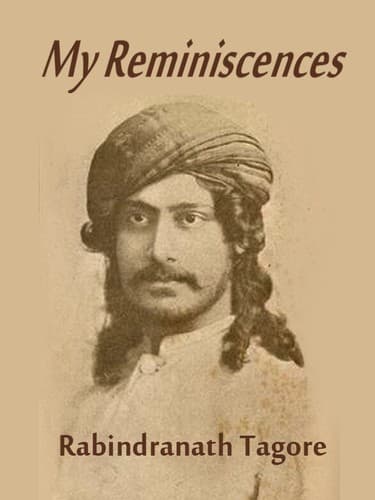
Authors, Bengali -- 20th century -- Biography; Tagore, Rabindranath, 1861-1941
The main object of teaching is not to explain meanings, but to knock at
the door of the mind. If any boy is asked to give an account of what is
awakened in him at such knocking, he will probably say something very
silly. For what happens within is much bigger than what he can express
in words. Those who pin their faith on University examinations as a test
of all educational results take no account of this fact.
I can recollect many things which I did not understand, but which
stirred me deeply. Once, on the roof terrace of our river-side villa, my
eldest brother, at the sudden gathering of clouds, repeated aloud some
stanzas from Kalidas's "Cloud Messenger." I could not, nor had I the
need to, understand a word of the Sanskrit. His ecstatic declamation of
the sonorous rhythm was enough for me.
Then, again, before I could properly understand English, a profusely
illustrated edition of "The Old Curiosity Shop" fell into my hands. I
went through the whole of it, though at least nine-tenths of the words
were unknown to me. Yet, with the vague ideas I conjured up from the
rest, I spun out a variously coloured thread on which to string the
illustrations. Any university examiner would have given me a great big
zero, but the reading of the book had not proved for me quite so empty
as all that.
Another time I had accompanied my father on a trip on the Ganges in his
houseboat. Among the books he had with him was an old Fort William
edition of Jayadeva's _Gita Govinda_. It was in the Bengali character.
The verses were not printed in separate lines, but ran on like prose. I
did not then know anything of Sanskrit, yet because of my knowledge of
Bengali many of the words were familiar. I cannot tell how often I read
that _Gita Govinda_. I can well remember this line:
The night that was passed in the lonely forest cottage.
It spread an atmosphere of vague beauty over my mind. That one Sanskrit
word, Nibhrita-nikunja-griham, meaning "the lonely forest cottage" was
quite enough for me.
I had to discover for myself the intricate metre of Jayadeva, because
its divisions were lost in the clumsy prose form of the book. And this
discovery gave me very great delight. Of course I did not fully
comprehend Jayadeva's meaning. It would hardly be correct to aver that I
had got it even partly. But the sound of the words and the lilt of the
metre filled my mind with pictures of wonderful beauty, which impelled
me to copy out the whole of the book for my own use.
Public-domain text, read in full here on John Shaqi.
Reviews
Reviews
No reviews yet
Be the first to share your thoughts on this work.
Join the Discussion
Join the discussion
Sign in to leave a comment or review.
Sign InorCreate an account