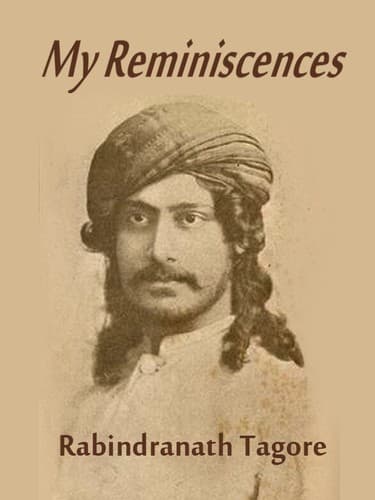
Authors, Bengali -- 20th century -- Biography; Tagore, Rabindranath, 1861-1941
I had read in some work of Herbert Spencer's that speech takes on
tuneful inflexions whenever emotion comes into play. It is a fact that
the tone or tune is as important to us as the spoken word for the
expression of anger, sorrow, joy and wonder. Spencer's idea that,
through a development of these emotional modulations of voice, man found
music, appealed to me. Why should it not do, I thought to myself, to act
a drama in a kind of recitative based on this idea. The _Kathakas_[47]
of our country attempt this to some extent, for they frequently break
into a chant which, however, stops short of full melodic form. As blank
verse is more elastic than rhymed, so such chanting, though not devoid
of rhythm, can more freely adapt itself to the emotional interpretation
of the text, because it does not attempt to conform to the more rigorous
canons of tune and time required by a regular melodic composition. The
expression of feeling being the object, these deficiencies in regard to
form do not jar on the hearer.
Encouraged by the success of this new line taken in the _Valmiki
Pratibha_, I composed another musical play of the same class. It was
called the _Kal Mrigaya_, The Fateful Hunt. The plot was based on the
story of the accidental killing of the blind hermit's only son by King
Dasaratha. It was played on a stage erected on our roof-terrace, and the
audience seemed profoundly moved by its pathos. Afterwards, much of it
was, with slight changes, incorporated in the _Valmiki Pratibha_, and
this play ceased to be separately published in my works.
Long afterwards, I composed a third musical play, _Mayar Khela_, the
Play of _Maya_, an operetta of a different type. In this the songs were
important, not the drama. In the others a series of dramatic situations
were strung on a thread of melody; this was a garland of songs with just
a thread of dramatic plot running through. The play of feeling, and not
action, was its special feature. In point of fact I was, while composing
it, saturated with the mood of song.
The enthusiasm which went to the making of _Valmiki Pratibha_ and _Kal
Mrigaya_ I have never felt for any other work of mine. In these two the
creative musical impulse of the time found expression.
My brother, Jyotirindra, was engaged the live-long day at his piano,
refashioning the classic melodic forms at his pleasure. And, at every
turn of his instrument, the old modes took on unthought-of shapes and
expressed new shades of feeling. The melodic forms which had become
habituated to their pristine stately gait, when thus compelled to march
to more lively unconventional measures, displayed an unexpected agility
and power; and moved us correspondingly. We could plainly hear the tunes
speak to us while Akshay Babu and I sat on either side fitting words to
them as they grew out of my brother's nimble fingers. I do not claim
that our _libretto_ was good poetry but it served as a vehicle for the
tunes.
Public-domain text, read in full here on John Shaqi.
Reviews
Reviews
No reviews yet
Be the first to share your thoughts on this work.
Elsewhere in the archive
Join the Discussion
Join the discussion
Sign in to leave a comment or review.
Sign InorCreate an account