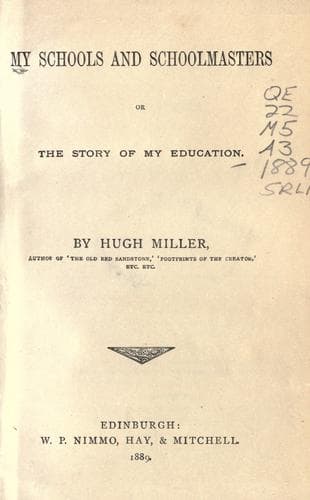
My Schools and Schoolmasters; Or, The Story of My EducationMiller, Hugh
Philosophy
My Schools and Schoolmasters; Or, The Story of My Education
Miller, Hugh
Education -- Scotland -- History -- 19th century; Geologists -- Scotland -- Biography; Miller, Hugh, 1802-1856 -- Knowledge and learning
"Such is the scene seen at right angles with the plane in which the
planets move; but what would be its aspect if I saw it in the line
of the plane? What would be its appearance if I saw it edgewise?
There arises in my mind one of those uncertainties which so
frequently convince me that I am ignorant. I cannot complete my
picture, for I do not know whether all the planets move in one
plane. How determine the point? A ray of light breaks in. Huzza! I
have found it. If the courses of the planets as seen in the heavens
form parallel lines, then must they all move in one plane; and
_vice versa_. But hold! That would be as seen from the sun--if the
planets _could_ be seen from the sun. The earth is but one of their
own number, and from it the point of view must be disadvantageous.
The diurnal motion must perplex. But no. The apparent motion of
the heavens need not disturb the observation. Let the course of the
planets through the fixed stars, be marked, and though, from the
peculiarity of the point of observation, their motion may at one
time seem more rapid, and at another more slow, yet, if their plane
be, as a workman would say, _out of twist_, their lines will seem
parallel. Still in some doubt, however: I long for a glance at an
Orrery, to determine the point; and then I remember that Ferguson,
an untaught man like myself, had made more Orreries than any one
else, and that mechanical contrivances of the kind were the natural
recourse of a man unskilled in the higher geometry. But it would be
better to be a mathematician than skilful in contriving Orreries. A
man of the Newtonian cast of mind, and accomplished in the
Newtonian learning, could solve the problem where I sat, without an
Orrery.
"From the thing contemplated, I pass to the consideration of the
mind that contemplates. Oh! that wonderful Newton, respecting whom
the Frenchman inquired whether he ate and slept like other men! I
consider how one mind excels another; nay, how one man excels a
thousand; and, by way of illustration, I bethink me of the mode of
valuing diamonds. A single diamond that weighs fifty carats is
deemed more valuable than two thousand diamonds, each of which only
weighs one. My illustration refers exclusively to the native
powers; but may it not, I ask, bear also on the acquisition of
knowledge? Every new idea added to the stock already collected is a
carat added to the diamond; for it is not only valuable in itself,
but it also increases the value of all the others, by giving to
each of them a new link of association.
Public-domain text, read in full here on John Shaqi.
Reviews
Reviews
No reviews yet
Be the first to share your thoughts on this work.
Elsewhere in the archive
Join the Discussion
Join the discussion
Sign in to leave a comment or review.
Sign InorCreate an account