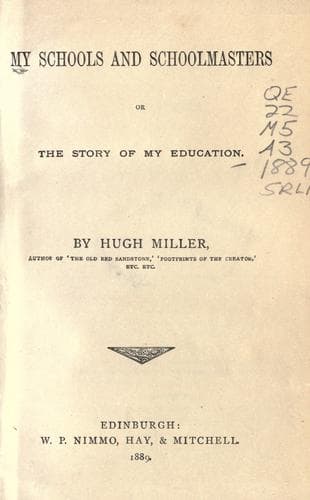
My Schools and Schoolmasters; Or, The Story of My EducationMiller, Hugh
Philosophy
My Schools and Schoolmasters; Or, The Story of My Education
Miller, Hugh
Education -- Scotland -- History -- 19th century; Geologists -- Scotland -- Biography; Miller, Hugh, 1802-1856 -- Knowledge and learning
ideas, and men of the most robust intellects, such as the Chalmerses,
Fosters, and Halls of the Christian Church, find themselves equally able
to rest their salvation on the _man_ "Christ, who is over all, _God_
blessed for ever." Of this fundamental truth of the two natures, that
condensed enunciation of the gospel which forms the watchword of our
faith, "Believe in the Lord Jesus Christ, and thou shalt be saved," is a
direct and palpable embodiment; and Christianity is but a mere name
without it.
I was impressed at this time by another very remarkable feature in the
religion of Christ in its subjective character. Kames, in his "Art of
Thinking," illustrates, by a curious story, one of his observations on
the "nature of man." "Nothing is more common," he says, "than love
converted into hatred; and we have seen instances of hatred converted
into love." And in exemplifying the remark, he relates his anecdote of
"Unnion and Valentine." Two English soldiers, who fought in the wars of
Queen Anne--the one a petty officer, the other a private sentinel--had
been friends and comrades for years; but, quarrelling in some love
affair, they became bitter enemies. The officer made an ungenerous use
of his authority, and so annoyed and persecuted the sentinel as almost
to fret him into madness; and he was frequently heard to say that he
would die to be avenged of him. Whole months were spent in the
infliction of injuries on the one side, and in the venting of complaints
on the other; when, in the midst of their mutual rage, they were both
selected, as men of tried courage, to share in some desperate attack,
which was, however, unsuccessful; and the officer, in the retreat, was
disabled, and struck down by a shot in the thigh. "Oh, Valentine! and
will you leave me here to perish?" he exclaimed, as his old comrade
rushed past him. The poor injured man immediately returned; and, in the
midst of a thick fire, bore off his wounded enemy to what seemed a place
of safety, when he was struck by a chance ball, and fell dead under his
burden. The officer, immediately forgetting his wound, rose up, tearing
his hair; and, throwing himself on the bleeding body, he cried, "Ah,
Valentine! and was it for me, who have so barbarously used thee, that
thou hast died? I will not live after thee." He was not by any means to
be forced from the corpse; but was removed with it bleeding in his arms,
and attended with tears by all his comrades, who knew of his harshness
to the deceased. When brought to a tent, his wounds were dressed by
force; but the next day, still calling on Valentine, and lamenting his
cruelties to him, he died in the pangs of remorse and despair.
Public-domain text, read in full here on John Shaqi.
Reviews
Reviews
No reviews yet
Be the first to share your thoughts on this work.
Elsewhere in the archive
Join the Discussion
Join the discussion
Sign in to leave a comment or review.
Sign InorCreate an account