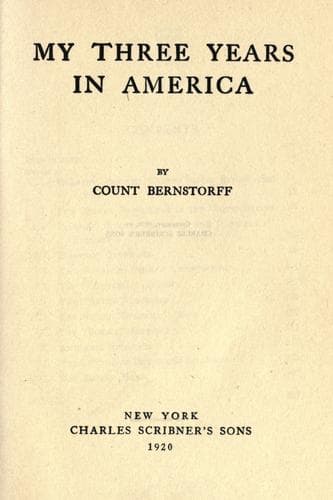
My Three Years in AmericaBernstorff, Johann Heinrich, Graf von
History
My Three Years in America
Bernstorff, Johann Heinrich, Graf von
Germany -- Foreign relations -- United States; United States -- Foreign relations -- Germany; World War, 1914-1918
President Taft, who in the year 1909 took President Roosevelt's
place, endeavored, with his Secretary of State, Philander Knox, to
develop still further the policy of the "Open Door," inaugurated
by John Hay. Both gentlemen felt the keenest interest in the Far
East. The former had been Governor of the Philippines, the latter had
been closely connected with the Pittsburgh iron industry, and knew
the need of extending its sphere of activities. Mr. Knox suggested
the proposal of internationalizing the railways of Manchuria. When,
however, this American notion met with response in Germany, and
apart from its general rejection elsewhere, had the further effect
of drawing Japan and Russia together again, Mr. Knox abandoned his
active Far-Eastern policy, and confined himself to stimulating the
large banks of America into becoming interested in the building of
railways and other economic means of development in China. This policy
was described as "Dollar Diplomacy" by the Democratic Opposition,
and violently opposed. When, therefore, the votes went against the
Republican Party, and President Wilson came to the helm, he let
the Far-Eastern policy drop. High Finance immediately seized this
opportunity in order to extricate itself from Chinese undertakings.
It had only embarked upon "Dollar Diplomacy" at the request of the
Government, and the venture had yielded but little profit, owing
to the fact that Americans are not inclined to invest in foreign
securities.
Secretary of State Knox's policy, which was always supported by
us, accounted for the fact that the official relations between
the German and American Governments were never more cordial than
during the years 1909-13, in spite of a short disturbance resulting
from a dispute over our potash exports to the United States. The best
proof of how friendly the official relations of the two Governments
were is shown by the ease with which this quarrel was settled. We
were also successful in concluding a commercial agreement which
was satisfactory to both sides, and overcame the danger of a customs
war as the result of America's new customs tariffs; whereas Taft's
economic plans, which aimed at reciprocity and union with Canada,
came to grief for political reasons, as the result of Canadian
Opposition, and left behind a bitter after-taste both in the United
States, Canada and England.
Public-domain text, read in full here on John Shaqi.
Reviews
Reviews
No reviews yet
Be the first to share your thoughts on this work.
Join the Discussion
Join the discussion
Sign in to leave a comment or review.
Sign InorCreate an account