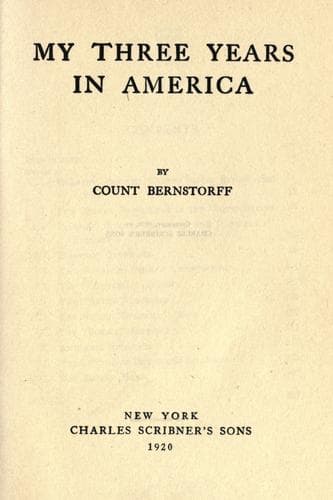
My Three Years in AmericaBernstorff, Johann Heinrich, Graf von
History
My Three Years in America
Bernstorff, Johann Heinrich, Graf von
Germany -- Foreign relations -- United States; United States -- Foreign relations -- Germany; World War, 1914-1918
Finally, a further cause of misunderstandings, as I have already
mentioned in the Introduction, was to be found in the general disfavor
with which American pacifist tendencies were regarded in Germany.
Nine-tenths of the American nation are pacifists, either through their
education and sentimental prepossession in favor of the principle,
or out of a sense of commercial expediency. People in the United
States did not understand that the German people, owing to their
tragic history, are compelled to cultivate and to uphold the martial
spirit of their ancestors. The types of the German officer of the
reserve and of the members of the student corps are particularly
unsympathetic to the American, and, for certain German foibles,
all sign of that understanding that readily forgives, is entirely
absent in the United States, owing to the fact that our historical
development is not realized over there.
Although the Americans are largely and unconsciously swayed by the
influence of English ideas, we must be careful to avoid falling into
the error, so common in Germany, of regarding them as Anglo-Saxons.
The Americans themselves, in their own country, scarcely ever call
themselves Anglo-Saxons. This term is used by the English when
they are anxious to claim their American cousins as their own.
Occasionally, too, an American may use the expression when making
an after-dinner speech at some fraternizing function. As a rule,
however, the Americans insist on being Americans, and nothing else.
On the 11th May, 1914, at a memorial service for the men who fell
at Vera Cruz, President Wilson, in one of his finest speeches,
said:
"Notice how truly these men were of our blood. I mean of our American
blood, which is not drawn from any one country, which is not drawn
from any one stock, which is not drawn from any one language of
the modern world; but free men everywhere have sent their sons
and their brothers and their daughters to this country in order
to make that great compounded nation which consists of all the
sturdy elements and of all the best elements of the whole globe. I
listened again to this list of the dead with a profound interest,
because of the mixture of the names, for the names bear the marks
of the several national stocks from which these men came. But they
are not Irishmen or Germans or Frenchmen or Hebrews or Italians
any more. They were not when they went to Vera Cruz; they were
Americans; every one of them, with no difference in their Americanism
because of the stock from which they came. They were in a peculiar
sense of our blood, and they proved it by showing that they were
of our spirit, that no matter what their derivation, no matter
where their people came from, they thought and wished and did the
things that were American; and the flag under which they served
was a flag in which all the blood of mankind is united to make
a free nation."
Public-domain text, read in full here on John Shaqi.
Reviews
Reviews
No reviews yet
Be the first to share your thoughts on this work.
Join the Discussion
Join the discussion
Sign in to leave a comment or review.
Sign InorCreate an account