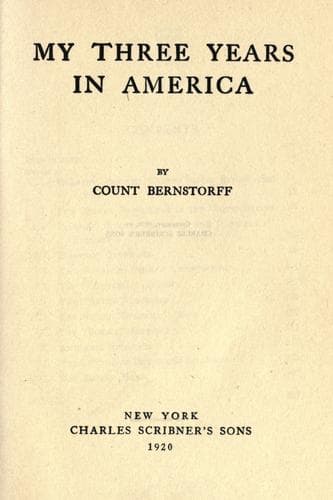
My Three Years in AmericaBernstorff, Johann Heinrich, Graf von
History
My Three Years in America
Bernstorff, Johann Heinrich, Graf von
Germany -- Foreign relations -- United States; United States -- Foreign relations -- Germany; World War, 1914-1918
Thus, before the outbreak of the Five-Years War, the majority of
Americans already looked upon the Germans, however unconsciously,
through the optics of the English Press and English literary
publications. A large number of people in the United States honestly
believed, moreover, in the rumored German scheme to seize the empire
of the world. Our enormous successes in the economic field provoked
unbounded admiration and led, on the one hand, to an over-estimation
of our power, which did not prove favorable to us politically,
while, on the other hand, the Americans who frequently indulged in
generalizations about Germany were prone to judge us according to
the German-American Beer-Philistine, whom they disdainfully called a
"Dutchman." The Americans' view of the German people wavered between
these two extremes; but every year opinion tended to incline more
and more in the direction of the former. The phantom of a German
world-empire, extending from Hamburg to Bagdad, had already taken
possession of the American mind long before the war; and in the
United States it was feared that the next step would be that this
world-empire would infringe the Monroe Doctrine and found colonies in
South America. Professor Baumgarten, in an entertaining book, has
pointed out to what extent the publications of the Pan-German party
contributed towards promoting such conceptions in America.
Our Press was a little too fond of making attacks on the Monroe
Doctrine in particular. I was always of the opinion that we ought,
openly and officially, to have recognized this American article of
faith. As regards the Monroe Doctrine, the question is not one of
Right, but one of Power. We certainly had not the power to infringe
the Monroe Doctrine, even if we had had the intention, which was never
the case. It would, therefore, have been more wise to acknowledge
it, and thus to improve the political attitude, towards ourselves,
of a country on which we were so very much dependent for a number
of our raw-material supplies. I have often wondered whether the
Imperial Government would not have regarded it as its duty to avoid
war at all costs, if our economic dependence upon foreign countries
had been more clearly recognized. German prosperity was based to
a great extent on the Germans overseas, who had settled down in
every corner of the earth, just as in former days the Greeks had
settled all over the Roman Empire. The Germans overseas constituted
a colonial empire, which was a far more precious source of wealth
than many a foreign possession belonging to other Powers. In my
opinion not sufficient allowance was made for this state of affairs.
Public-domain text, read in full here on John Shaqi.
Reviews
Reviews
No reviews yet
Be the first to share your thoughts on this work.
Join the Discussion
Join the discussion
Sign in to leave a comment or review.
Sign InorCreate an account