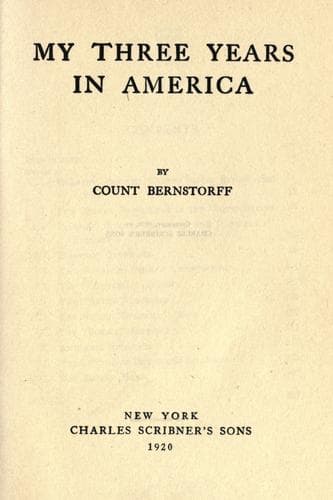
My Three Years in AmericaBernstorff, Johann Heinrich, Graf von
History
My Three Years in America
Bernstorff, Johann Heinrich, Graf von
Germany -- Foreign relations -- United States; United States -- Foreign relations -- Germany; World War, 1914-1918
Our Press in general, moreover, never revealed a sufficient amount
of interest or understanding in regard to American affairs. There
were only a very few German newspaper correspondents in the United
States, and those that did happen to be there were too poorly paid
to be able to keep properly in touch with American social life.
About twelve months before the war, the well-known wealthy
German-American, Hermann Sielcken, offered to help me out of this
difficulty by undertaking to pay the salary of a first-rate American
journalist, of German origin, who was to reside in Washington, and
act as the representative there of Wolff's telegraphic bureau.
I immediately took steps to organize this telegraphic service.
Very shortly afterwards, however, I was informed by Berlin, that
the telegrams would be too expensive, as the subject was not of
enough interest, and in this case the Wolff Bureau would only have
had to defray the cost of the actual telegrams. This was the way
the supply of news was organized in a country that imagined it
was practising world-politics.
Mr. Wilson took up his quarters in the White House, Washington,
about a year before the war, and opened his period of office with
several internal reforms. Then came the American-Mexican crisis,
and relations with Europe in general, and Germany in particular,
therefore, fell somewhat into the background.
Woodrow Wilson was a University don and an historian. His works
are distinguished by their brilliant style and the masterly manner
in which he wields the English language--a power which was also
manifested in his political speeches and proclamations. Mr. Wilson
sprang into political and general fame when he was President of the
University of Princeton, and was elected as Governor of the State
of New Jersey. Even in those days he displayed, side by side, on
the one hand, his democratic bias which led him violently to oppose
the aristocratic student-clubs, and on the other, his egocentric and
autocratic leanings which made him inaccessible to any advice from
outside, and constantly embroiled him with the governing council
of the University. As Governor of New Jersey, The Holy Land of
"Trusts," Mr. Wilson opened an extraordinarily sharp campaign against
their dominion. Mr. Roosevelt, it is true, had spoken a good deal
against the trusts, but he had done little. He could not, however,
have achieved much real success, because the Republican Party was
too much bound up with the trusts, and dependent on them. At the
time when Mr. Roosevelt wanted to take action, he also succeeded in
splitting up his party, so that real reform could only be expected
from the Democratic side. The conviction that this was so was the
cause of Mr. Wilson's success in the Presidential election of 1912.
Public-domain text, read in full here on John Shaqi.
Reviews
Reviews
No reviews yet
Be the first to share your thoughts on this work.
Join the Discussion
Join the discussion
Sign in to leave a comment or review.
Sign InorCreate an account