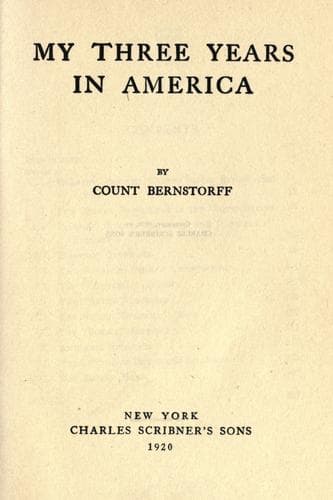
My Three Years in AmericaBernstorff, Johann Heinrich, Graf von
History
My Three Years in America
Bernstorff, Johann Heinrich, Graf von
Germany -- Foreign relations -- United States; United States -- Foreign relations -- Germany; World War, 1914-1918
In regard to external politics, Mr. Wilson was pacifistic, as was
also his party; whereas the Imperialists belonged almost without
exception to the Republican Party. In spite of "Wall Street," and
the influence of English ideas and opinions upon American society,
Pacifist tendencies largely prevailed in the United States before
the outbreak of the Five-Years War; how much more was this the case,
therefore, when Mr. Wilson, in accordance with American custom,
gave the post of Secretary of State to the politician to whose
influence he owed his nomination as candidate for the Presidency
by the Democratic Party. Thus did Mr. William Jennings Bryan attain
to the dignity of Secretary of State after he had thrice stood as
a candidate for the Presidency without success.
In all political questions, Mr. Bryan followed a much more radical
tendency than Mr. Wilson. His opponents call him a dishonest demagogue.
I, on the contrary, would prefer to call Mr. Bryan an honest visionary
and fanatic, whose passionate enthusiasm may go to make an exemplary
speechmaker at large meetings, but not a statesman whose concern is
the world of realities. He who in his enthusiasm believes he will
be able to see his ideal realized in this world next Thursday week
is not necessarily dishonest on that account, even if he overlooks
the fact that things are going very badly indeed.
It was believed in a large number of circles that Mr. Bryan would
not accept the post of Secretary of State, for even at that time
everybody who was in the know was already aware that Mr. Wilson could
only tolerate subordinates and not men with opinions of their own.
Mr. Bryan, however, felt the moral obligation, at least to attempt to
give his radical views a chance of succeeding, and declared, as he
took over the post, that so long as he was Secretary of State the
United States would never go to war. He even wanted this principle
to be generally accepted by the rest of the world, and with this
end in view, submitted to all foreign Governments the draft of
an Arbitration and Peace-Treaty, which was to make war utterly
impossible in the future. As is well known, the German Government,
unlike all the others, refused to fall in with Mr. Bryan's wishes.
The Secretary of State was a little mortified by this, even though
he still hoped that we should ultimately follow the example of
the other Powers. Every time we met, he used to remind me of his
draft Arbitration Treaty, which I had forwarded to Berlin. Later on
I often regretted that we did not fall in with Mr. Bryan's wishes;
who, by the by, during the war, again returned to the question, but
in vain. If the treaty had been signed by us, it would most probably
have facilitated the negotiations about the U-boat campaign.
Public-domain text, read in full here on John Shaqi.
Reviews
Reviews
No reviews yet
Be the first to share your thoughts on this work.
Join the Discussion
Join the discussion
Sign in to leave a comment or review.
Sign InorCreate an account