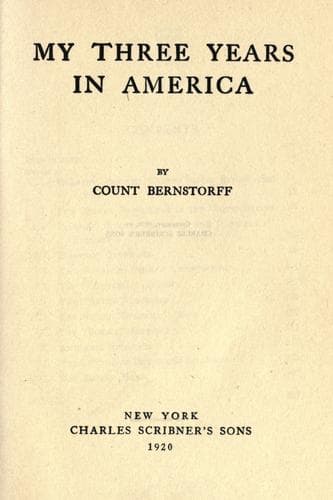
My Three Years in AmericaBernstorff, Johann Heinrich, Graf von
History
My Three Years in America
Bernstorff, Johann Heinrich, Graf von
Germany -- Foreign relations -- United States; United States -- Foreign relations -- Germany; World War, 1914-1918
On the other hand, I will not deny, that even the Oriental Policy
would have proved a feasible political scheme, if only we had decided
to pursue it in good time. Albeit, I am of opinion that even Bismarck
had already started us in the direction of the Western Policy, when
in 1879 he decided in favor of Austria-Hungary and not Russia.
Despite all that the careworn recluse of Friedrichsruhe may have
written against Caprivi's policy, which was decidedly Western in
tendency, he was himself the founder of the Triple Alliance, which,
without the good-will of England, could not have come into existence.
Had we pursued an Eastern Policy, though it would ultimately have
led to the sacrifice and partition of Austria-Hungary, it would not
have secured us those advantages in the Orient of which Marschall
speaks. Nevertheless, I have always regretted that we sent such a
first-rate man to Constantinople, for him ultimately to become the
able director of the false policy which we pursued there. There
is an Oriental proverb which says: "Never lay your load on a dead
camel's back."
If, as I always used to hope, we had resolved to adopt the Western
Policy, we should in any case have had to be prepared, in certain
circumstances, to venture with England's help upon a war against
Russia. And the experiences of the Five-Years War have taught us that
we should have won such a conflict with ease. I never wanted a war
with Russia, and was never an enemy of that country; but I believed
that our position among the nations of the world would compel us to
decide one way or the other, and I felt, just as Caprivi did, that
we should not very well be able to avoid war. Even if, in the event
of a war between the Triple Alliance and Russia and France, England
had only maintained an attitude of friendly neutrality, this would
have proved very much more favorable for us than the situation which
developed out of the Encirclement Policy (_Einkreisungspolitik_).
Furthermore, had we pursued the Western Policy, we should have had
to reckon with the possibility of England's wishing to moderate,
even in a perfectly friendly manner, our somewhat explosive economic
development. I should not, however, have regarded this altogether as
a disadvantage. For, truth to tell, we grew a little too rapidly.
We ought, as "junior partners" in Britain's world-empire, to have
gathered our strength more slowly. As an example of what I mean, take
the policy which France and Japan have pursued since the beginning
of the present century. If we had done the same, we should, at all
events, have been saved from so seriously overheating the boilers
of our industrial development, we should not have outstripped England
as quickly as we undoubtedly could have done if we had been left to
develop freely, but we should also have escaped the mortal danger
which we drew upon ourselves by provoking universal hostility.
Public-domain text, read in full here on John Shaqi.
Reviews
Reviews
No reviews yet
Be the first to share your thoughts on this work.
Join the Discussion
Join the discussion
Sign in to leave a comment or review.
Sign InorCreate an account