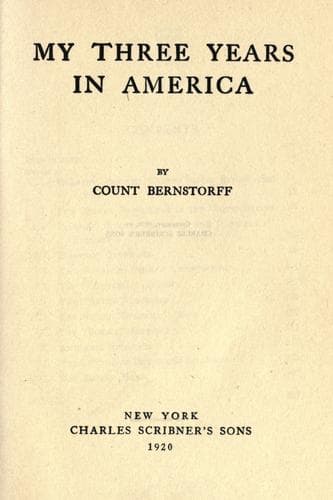
My Three Years in AmericaBernstorff, Johann Heinrich, Graf von
History
My Three Years in America
Bernstorff, Johann Heinrich, Graf von
Germany -- Foreign relations -- United States; United States -- Foreign relations -- Germany; World War, 1914-1918
It is impossible now for me to demonstrate retrospectively that we
should have been able to conclude an alliance with England. Prince
Bülow denies that this was ever the case. Maybe that during his tenure
of office this possibility did not offer a sufficient guarantee of
future security to warrant our incurring the hostility of Russia. I
am convinced, however, that an alliance with England would have been
within our power, if we had pursued Caprivi's policy consistently,
and the Kruger telegram had never been dispatched. Unfortunately we
have always had statesmen at the helm in Germany,--Bismarck not
excepted,--the bulk of whose views and knowledge were essentially
continental, and who never felt quite at home with English ways
of thinking. I feel perfectly satisfied on this point, however,
that English commercial jealousy, with which we naturally had to
reckon, would not have proved an insuperable obstacle to a good
understanding with England, provided that we had declared ourselves
ready, if necessary, to fight Russia.
The policy of the free hand, which we pursued until the outbreak
of war, aimed at the highest possible results. Prince Bülow, who
was the inaugurator of this policy, might possibly have known how
to steer us through the "Danger-Zone" without provoking war. And
then in a few years to come, we should have become so strong and
should have left the Danger-Zone so very far behind us, that, as
far as human judgment could tell, we should no longer have had any
need to fear war. German naval construction from the beginning of the
present century certainly made our relationship to England very much
worse, while it also materially increased the danger of our position
from the standpoint of world-politics. The Bülow-Tirpitz notion of
a _Risikoflotte,_[*] may, however, only have been practicable on
condition that our diplomacy were sufficiently skilful to avoid
war, as long as the "risk" idea in England was not able, of itself,
to maintain peace.
[Footnote *: Literally: a fleet for risks or for taking risks; a
fleet to be used at a venture.]
Public-domain text, read in full here on John Shaqi.
Reviews
Reviews
No reviews yet
Be the first to share your thoughts on this work.
Join the Discussion
Join the discussion
Sign in to leave a comment or review.
Sign InorCreate an account