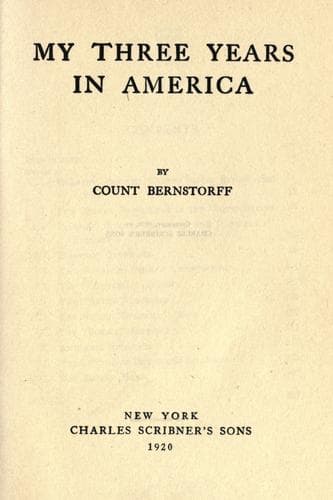
My Three Years in AmericaBernstorff, Johann Heinrich, Graf von
History
My Three Years in America
Bernstorff, Johann Heinrich, Graf von
Germany -- Foreign relations -- United States; United States -- Foreign relations -- Germany; World War, 1914-1918
President Wilson, who by inclination and habit is a recluse and
a lonely worker, does not like company. He re-introduced the old
etiquette and confined himself only to visiting the houses of Cabinet
members, which had been the customary tradition. He also kept himself
aloof from the banquets, which are such a favorite feature of social
life in America, and severely limited the company at the White
House. Thus the New Year Reception was discontinued entirely. This
attitude on the part of the President was the outcome of his tastes
and inclinations. But I certainly do not believe that he simply
developed a theory out of his own peculiar tastes, as so often
happens in life. I am more inclined to believe that Mr. Wilson
regarded the old American tradition as more expedient, on the grounds
that it enabled the President to remain free from all intimacy,
and thus to safeguard the complete impartiality which his high
office demanded. The peculiar friendship which unites Mr. Wilson
with Mr. House is no objection to this theory, for the latter has
to some extent always been in the position of a minister without
portfolio. An adviser of this sort, who incurs no responsibility by
the advice he gives, is more readily accepted by American opinion
than by any other, because the President of the United States is
known to be alone and exclusively responsible, whereas his ministers
are only looked upon as his assistants.
Generally speaking, the political situation in the United States
before the Five-Years War was as follows: On the one hand, owing
to the influence of English ideas, which I have already mentioned,
it was to be expected that a feeling of sympathy with the Entente
would probably preponderate in the public mind; while on the other
hand, owing to the general indifference that prevailed with regard to
all that happened in Europe, and to the strong pacifist tendencies,
no interference in the war was to be expected from America, unless
unforeseen circumstances provoked it. At all events it was to be
feared that the inflammability of the Americans' feelings would
once again be under-estimated in Germany, as it had been already.
It has never been properly understood in our country, despite the
fact that the Manila and Venezuela affairs might have taught us a
lesson in this respect. The juxtaposition in the American people's
character of Pacifism and an impulsive lust of war should have been
known to us, if more sedulous attention had been paid in Germany to
American conditions and characteristics. The American judges affairs
in Europe, partly from the standpoint of his own private sentiment of
justice, and partly under the guidance of merely emotional values;
but not, as was generally supposed in Germany, simply from a cold
and business-like point of view. If this had been reckoned with in
Germany, the terrible effect upon public opinion in America of the
invasion of Belgium and of the sinking of the _Lusitania_--particularly
Public-domain text, read in full here on John Shaqi.
Reviews
Reviews
No reviews yet
Be the first to share your thoughts on this work.
Join the Discussion
Join the discussion
Sign in to leave a comment or review.
Sign InorCreate an account