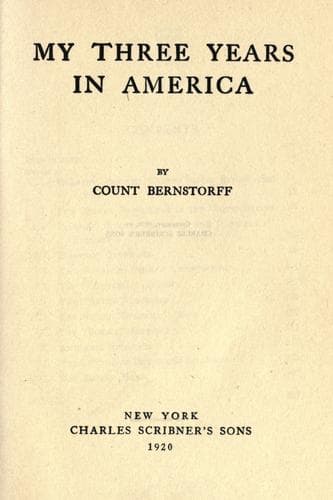
My Three Years in AmericaBernstorff, Johann Heinrich, Graf von
History
My Three Years in America
Bernstorff, Johann Heinrich, Graf von
Germany -- Foreign relations -- United States; United States -- Foreign relations -- Germany; World War, 1914-1918
in view of the influence of English propaganda--would have been
adequately valued from the start.
On May 17th, 1915, in a report addressed to the Imperial Chancellor,
I wrote as follows:
"It is not a bit of good glossing over things. Our best plan, therefore,
is frankly to acknowledge that our propaganda in this country has,
as the result of the _Lusitania_ incident, completely collapsed.
To everyone who is familiar with the American character this could
have been foreseen. I therefore beg leave to point out in time,
that another event like the present one would certainly mean war
with the United States. Side by side in the American character
there lie two apparently completely contradictory traits. The cool,
calculating man of business is not recognizable when he is deeply
moved and excited--that is to say, when he is actuated by what is
here called 'emotion.' At such moments he can be compared only
to an hysterical woman, to whom talking is of no avail. The only
hope is to gain time while the attack passes over. At present it is
impossible to foresee what will be the outcome of the _Lusitania_
incident. I can only hope that we shall survive it without war. Be
this as it may, however, we can only resume our propaganda when
the storm has subsided."
Here I should like to intrude a few of my own views regarding the
importance of public opinion in the United States.
In Europe, where people are constantly hearing about the truly
extraordinary and far-reaching authority of the American President--the
London _Times_ once said that, after the overthrow of the Russian
Czar, the President of the United States was the last remaining
autocrat--it is difficult to form a correct estimate of the power
of public opinion in the Union. In America, just as no mayor can
with impunity ignore the public opinion of his city, and no governor
the public opinion of his state, so the President of the Republic,
despite his far-reaching authority, cannot for long run counter to
the public opinion of his country. The fact has often been emphasized
by Mr. Wilson himself, among others, that the American President
must "keep his ear to the ground"--that is to say, must pay strict
attention to public opinion and act in harmony with it. For the
American statesman, whose highest ambition consists either in being
re-elected, or at least in seeing his party returned to power, any
other course would amount to political suicide; for any attempt
at swimming against the tide will certainly be avenged at the next
elections.
Public-domain text, read in full here on John Shaqi.
Reviews
Reviews
No reviews yet
Be the first to share your thoughts on this work.
Join the Discussion
Join the discussion
Sign in to leave a comment or review.
Sign InorCreate an account