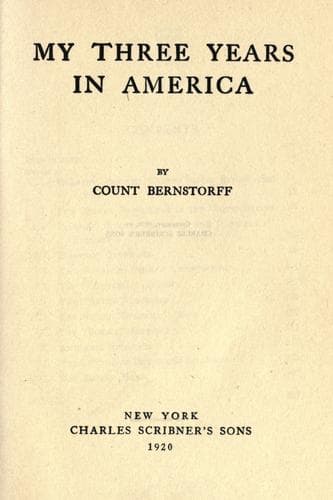
My Three Years in AmericaBernstorff, Johann Heinrich, Graf von
History
My Three Years in America
Bernstorff, Johann Heinrich, Graf von
Germany -- Foreign relations -- United States; United States -- Foreign relations -- Germany; World War, 1914-1918
On our side, it is true, and I should like to emphasize this to their
credit, that on the outbreak of war the German-American newspapers
took up our cause unhesitatingly and as one man. Further, they
have, until America's entry into the war, honestly striven to win
full justice for the American point of view, and to combat the
unneutral leanings of the majority of the Americans and the slanderous
attacks of our enemies. As, however, they are not accessible to the
general public, who do not know German, and in particular scarcely
ever come into the hands of the authoritative American political
circles, their support remained more or less academic. Very valuable
services were rendered to the German cause by the already-mentioned
weekly paper _Fatherland_, which was printed in English; in view,
however, of its reputation as a partisan journal, it naturally
could not exert so deep an influence as the local daily papers,
which carried on the English propaganda without allowing it to
become too conspicuous. For telegraphic communication from Germany
to America we had to rely solely on the two German wireless stations
at Sayville and Tuckerton, erected shortly before the outbreak of
war, and we soon succeeded, subject to American censorship, in
getting a regular Press-service, which was spread, not only over
the whole of the United States, but was also passed on to South
America and East Asia. But in the first place, in spite of repeated
extension and strengthening, these two stations were quite inadequate;
in the second place, the Press-service never succeeded in adapting
itself thoroughly to American requirements. The same may be said
of most of the German propaganda literature which reached America
in fairly large quantities since the third month of the war, partly
in German and partly in not always irreproachable English. This,
like the Press telegrams, showed a complete lack of understanding
of American national psychology. The American character, I should
like to repeat here, is by no means so dry and calculating as the
German picture of an American business man usually represents.
The outstanding characteristic of the average American is rather
a great, even though superficial, sentimentality. There is no news
for which a way cannot be guaranteed through the whole country,
if clothed in a sentimental form. Our enemies have exploited this
circumstance with the greatest refinement in the case of the German
invasion of "poor little Belgium," the shooting of the "heroic
nurse," Edith Cavell, and other incidents. Those who had charge
of the Berlin propaganda, on the other hand, made very little of
such occurrences on the enemy side, e.g., the violation of Greece,
the bombing of the Corpus Christi procession in Karlsruhe, etc. One
thing that would have exerted a tremendous influence in America,
if its publicity had been handled with only average skill, was
the sufferings of our children, women and old people as a result
Public-domain text, read in full here on John Shaqi.
Reviews
Reviews
No reviews yet
Be the first to share your thoughts on this work.
Join the Discussion
Join the discussion
Sign in to leave a comment or review.
Sign InorCreate an account