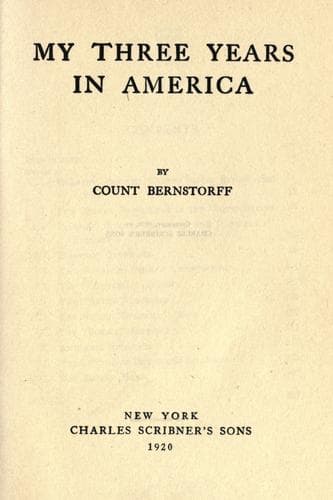
My Three Years in AmericaBernstorff, Johann Heinrich, Graf von
History
My Three Years in America
Bernstorff, Johann Heinrich, Graf von
Germany -- Foreign relations -- United States; United States -- Foreign relations -- Germany; World War, 1914-1918
of the British hunger blockade--that they have made no attempt
to bring to the notice of the world.
On the other hand they put themselves to the greatest possible
trouble to lay "The Truth About the War" before American public
opinion. This, however, fell on unfavorable ground, for the American
does not care to be instructed. He had no interest in learning
the "truth" which the German Press communications and explanatory
pamphlets were so anxious to impress upon him. The American likes
to form his own opinions and so only requires facts. The possibility
of exerting influence therefore lies rather in the choice of the
facts and the way in which they are presented, than in logical
and convincing argument. It is all the easier to influence him by
the well-timed transmission of skilfully disposed facts, since his
usually very limited general knowledge and his complete ignorance of
European affairs deprive him of the simplest premises for a critical
judgment of the facts presented to him from the enemy side. It is
quite incredible what the American public will swallow in the way
of lies if they are only repeated often enough and properly served
up. It all turns on which side gets the news in first; for the first
impression sticks. Corrections are generally vain, especially as
they appear as a rule in small print and in inconspicuous places.
When, for example, the American Press got the first news of the
"destruction" of Rheims cathedral from London and in the English
version, no German correction, however well-founded, would succeed
in removing the first impression.
Particularly ineffective in their influence on American public
opinion--as may be said here in anticipation--have been the majority
of our official Notes. In view of the subsequent ever-increasing
interruption of the news service from Germany, they were the last
and only means by which the German standpoint could be brought
before the American people. Their effectiveness depended entirely
on the impression that they made on American public opinion and
not on the Washington Government; yet they were nearly always drawn
up in Berlin in the form of juristic précis, propagandist but quite
futile.
All these factors must be taken into consideration in attempting
to estimate the success of our propaganda in the United States.
They show that on the one hand the prevailing conditions of American
public opinion were extraordinarily unfavorable to our propaganda,
and that the support it received from home, with a few exceptions,
was misguided.
Public-domain text, read in full here on John Shaqi.
Reviews
Reviews
No reviews yet
Be the first to share your thoughts on this work.
Join the Discussion
Join the discussion
Sign in to leave a comment or review.
Sign InorCreate an account