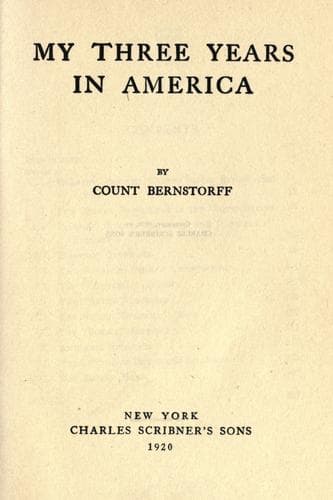
My Three Years in AmericaBernstorff, Johann Heinrich, Graf von
History
My Three Years in America
Bernstorff, Johann Heinrich, Graf von
Germany -- Foreign relations -- United States; United States -- Foreign relations -- Germany; World War, 1914-1918
The policy outlined in these quotations from Mr. Wilson's proclamation
won the approval of an overwhelming majority of the American people,
for even among the supporters of the Entente there was only a small
minority who desired an active participation in the war by the
United States. Apart from the fact that the traditional American
policy seemed to preclude any such intervention in European affairs,
it was to the interest of the United States to play with unimpaired
power the rôle of _Arbiter mundi_, when the States of ancient Europe,
tired of tearing one another to pieces, at last longed for peace
again. America could not but hope that neither of the two warring
parties would come out of the war in a dominating position. There
is, therefore, a certain modicum of truth in the view frequently
expressed in Germany that the United States would in any case finally
have entered the war to prevent the so-called "German Peace." But
the question is whether such a peace was possible in face of the
superior strength of our enemies. If we had won the first battle
of the Marne and had then been prepared to restore Belgium and
conclude a moderate peace, it is conceivable that we might have
come to terms with England on the basis of a kind of Treaty of
Amiens. After the loss of the battle of the Marne a "German Peace"
was out of the question. The possibility of such a peace has never
recurred. It was therefore necessary for the German policy to strive
for a peace by understanding on the basis of the _status quo_.
Just as Frederick the Great defended Prussia's newly won position
as a great Power against overwhelming odds, so we were fighting
under similar conditions for the maintenance of Germany's position
in the world.
Our Government had declared _urbi et orbi_ that they were waging a
defensive war, and were therefore obliged to regulate their policy
accordingly. If we had desired a peace like that of Hubertusburg we
should have won. It is often contended in Germany to-day that it
would still have been possible to attain this end. I have struggled
for it in America for two and a half years and am as convinced
to-day as I was then, that by acquiescing in the policy of the
United States we should have obtained a peace which would have
met the needs of the German people, if only those who desired the
same thing at home had been in a position to carry their wishes
through.
Public-domain text, read in full here on John Shaqi.
Reviews
Reviews
No reviews yet
Be the first to share your thoughts on this work.
Join the Discussion
Join the discussion
Sign in to leave a comment or review.
Sign InorCreate an account