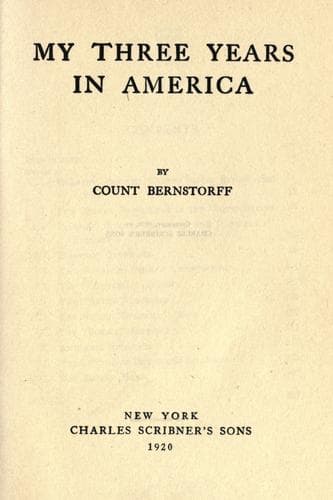
My Three Years in AmericaBernstorff, Johann Heinrich, Graf von
History
My Three Years in America
Bernstorff, Johann Heinrich, Graf von
Germany -- Foreign relations -- United States; United States -- Foreign relations -- Germany; World War, 1914-1918
In Germany it is also alleged, contrary to my own opinion, that the
German people could not have held out if they had not been driven
on by the "Will to conquer." I regard this view as an injustice to
the German nation. If our home propaganda, instead of continually
awakening vain hopes, had insisted on telling the real truth, the
German people would have faced danger to the last. We ought to
have repeated constantly that our situation was very serious, but
that we must clench our teeth, and our Government must be ready
to seize the first opportunity to end the defensive war by a
corresponding peace.
The controversy about the "German peace" or "peace by negotiation"
must be touched on here because it formed the nucleus of the diplomatic
struggle in Washington. At the beginning of the war these catchwords
had not yet been invented, but their substance even then controlled
the situation. The attitude of the American Government and public
opinion towards us depended in the first place on whether they
thought that we were striving for world-mastery or were waging a
defensive war.
Immediately after my return from Europe I called on President Wilson,
who had taken the opportunity of the war and the death of his first
wife, to withdraw even more than ever from the outer world. He was
generally known as the recluse of the White House. He only received
people with whom he had political business to settle. Particularly
from diplomats and other foreigners Mr. Wilson kept very aloof,
because he was anxious to avoid the appearance of preference or
partiality.
After the disillusionment of Versailles it is difficult for a German
to form an unbiassed judgment of Mr. Wilson. We must not forget,
however, that no serious attempt has ever been made in Germany
to get an unprejudiced estimate of Mr. Wilson's personality. In
the course of the war he has come to be regarded more and more
as unneutral and anti-German, whereas, to the average American
public opinion, he appeared in quite a different light. Later,
after the defeat of our arms, we hailed Mr. Wilson as the Messiah
who was to save Germany and the whole world from dire distress.
When, therefore, at Versailles, the President, instead of unfolding
and carrying through a far-reaching programme for the general
reconstruction of the world, approved all the ultra-chauvinistic
and nationalistic mistakes of the European statesmen and proclaimed
as the aim of the peace the punishment of Germany, Mr. Wilson was
set down in Germany without more ado as a hypocrite.
I think that through all the phases of the war the German opinion of
Mr. Wilson has suffered from sheer exaggeration. The chief mistake lay
in separating Wilson's personality from public opinion in the United
States. In spite of his strong will and his autocratic leanings, Mr.
Wilson is still, in the first place, a perfect type of the American
politician. In his speeches he always tries to voice public opinion,
and in his policy to follow its wishes.
Public-domain text, read in full here on John Shaqi.
Reviews
Reviews
No reviews yet
Be the first to share your thoughts on this work.
Join the Discussion
Join the discussion
Sign in to leave a comment or review.
Sign InorCreate an account