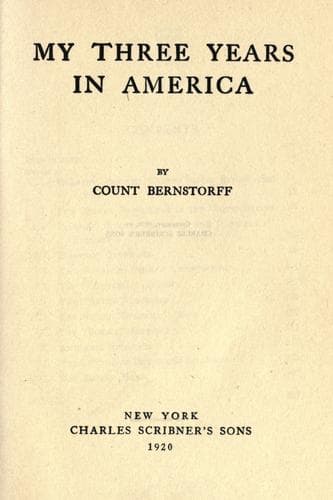
My Three Years in AmericaBernstorff, Johann Heinrich, Graf von
History
My Three Years in America
Bernstorff, Johann Heinrich, Graf von
Germany -- Foreign relations -- United States; United States -- Foreign relations -- Germany; World War, 1914-1918
My remark about the benevolence of the United States' neutrality
towards our enemies was at the time chiefly prompted by the differences
that had arisen with regard to the wireless stations.
The fact that this question arose gives yet another proof of how
little we were prepared for war. By German enterprise two wireless
stations had been erected on the east coast of the United States
as a means of direct communication with Europe, one at Sayville
(Long Island), the other at Tuckerton (New Jersey). Both were partly
financed by American and French capital. As at the beginning of the
war the cable fell entirely into English hands and was destroyed by
them, we had no telegraphic communication with home at our disposal.
We had to fall back exclusively on the wireless stations, when, as
frequently happened, we were unable to make use of the circuitous
routes via neutral countries. Unfortunately it appeared that the
legal position with regard to the proprietorship of the two stations
was not clear. Actions were immediately brought on the French side,
and the closing of the stations by decree of the courts demanded.
Under these circumstances it was fortunate for us that the American
Government, after tedious negotiations with me, took over possession
of both stations. Otherwise they would have been closed and we
should have been unable to use them.
Our satisfaction at this decision was modified by the establishment
of a censorship of radio-telegrams on the part of the American
Government on the strength of the Hague Convention, which prohibits
the communication by wireless from a neutral country with the military
or naval forces of a combatant. If the stations had been publicly
used before the war we should have stood on firm legal ground, for
such cases are excepted by the Hague Convention. Unfortunately the
stations were in 1914 only partially completed, and the application
of the clauses in question was therefore doubtful. It is true that
the stations were ready for immediate use, but as a result of the
French protest the American Government held strictly to the legal
standpoint. In these negotiations we had to content ourselves with
pointing out that whereas our enemies could pass on military information
to their Governments by means of coded cablegrams, we should be
confined to the use of the wireless stations. Finally we came to
an agreement with the American Government that they should have
a copy of the code which we used for the wireless telegrams. In
this way their contents were kept secret from the enemy, but not
from the Washington Government. This course we only agreed to as
a last resource as it was not suitable for handling negotiations
in which the American Government was concerned.
Public-domain text, read in full here on John Shaqi.
Reviews
Reviews
No reviews yet
Be the first to share your thoughts on this work.
Join the Discussion
Join the discussion
Sign in to leave a comment or review.
Sign InorCreate an account