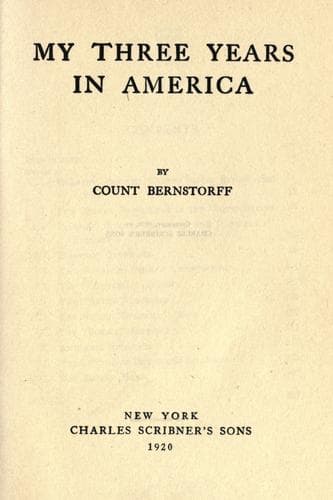
My Three Years in AmericaBernstorff, Johann Heinrich, Graf von
History
My Three Years in America
Bernstorff, Johann Heinrich, Graf von
Germany -- Foreign relations -- United States; United States -- Foreign relations -- Germany; World War, 1914-1918
Apart from this, Mr. Wilson at Versailles no longer dominated American
public opinion, and his political power consequently collapsed. In
the United States the old indifference to European affairs regained
the upper hand. Men were satisfied with having brought about a
victory over autocracy and militarism. They wanted nothing further.
The American troops were crowding home, and, finally, feeling in
the United States was still so strongly against us that no one
would have understood the President if he had caused a rupture with
his Allies on our behalf.
At Versailles, too, an outstanding peculiarity of Mr. Wilson's may
have played a part which even during the earlier negotiations had
been of great importance. He is a man who is slow to make up his
mind, and likes to postpone decisions until they are inevitable. He
is always ready to wait and see whether the situation may not improve
or some unexpected event occur. How often during the Washington
negotiations did, first I and then our enemies, believe that we had
set President Wilson on a definite course. But again and again
the requisite decision would be postponed. In Washington it was
generally taken under the strong pressure of public opinion. In
Versailles the Entente statesmen may well have forced a decision
by displaying a stronger will and a wider knowledge of European
affairs. Mr. Wilson was at Versailles in the position of the giant
Antæus, who drew his strength from his native soil. Once away from
American ground Hercules (Clemenceau) was able to crush him.
At the time I am now describing the circumstances were quite different,
because at that time Mr. Wilson had a reliable support for his
policy in American public opinion. In Germany, at the very beginning
of the war, great resentment was felt against Mr. Wilson for the
cold negative in his reply to the Emperor's telegram in which Mr.
Wilson was asked to condemn the atrocities perpetrated by the Belgian
population and _francs-tireurs_. It was not, however, noticed in
Germany that the President at the same time likewise refused to
receive a Belgian deputation which came to America to beg for his
help.
During my conversation with the President already mentioned, he
made a statement on the lines of his proclamation of neutrality
of which I have already given the substance. My reply that the
American neutrality seemed to us to be tinged with sympathy for
our enemies Mr. Wilson contradicted emphatically. He thought that
this appearance was the result of England's naval power, which
he could do nothing to alter. In this connection the President
made the following remark, which struck me very forcibly at the
time:
"The United States must remain neutral, because otherwise the fact
that her population is drawn from so many European countries would
give rise to serious domestic difficulties."
Public-domain text, read in full here on John Shaqi.
Reviews
Reviews
No reviews yet
Be the first to share your thoughts on this work.
Join the Discussion
Join the discussion
Sign in to leave a comment or review.
Sign InorCreate an account