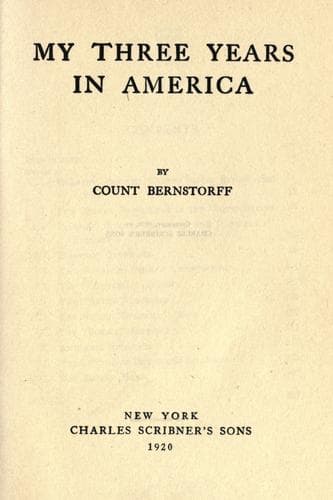
My Three Years in AmericaBernstorff, Johann Heinrich, Graf von
History
My Three Years in America
Bernstorff, Johann Heinrich, Graf von
Germany -- Foreign relations -- United States; United States -- Foreign relations -- Germany; World War, 1914-1918
"In the third place, I note with sincere regret that, in discussing
the sale and exportation of arms by citizens of the United States
to the enemies of Germany, Your Excellency seems to be under the
impression that it was within the choice of the Government of the
United States, notwithstanding its professed neutrality and its
diligent efforts to maintain it in other particulars, to inhibit
this trade, and that its failure to do so manifested an unfair
attitude toward Germany. This Government holds, as I believe Your
Excellency is aware, and as it is constrained to hold in view of
the present indisputable doctrines of accepted international law,
that any change in its own laws of neutrality during the progress
of a war which would affect unequally the relations of the United
States with the nations at war would be an unjustifiable departure
from the principle of strict neutrality by which it has consistently
sought to direct its actions, and I respectfully submit that none
of the circumstances urged in Your Excellency's memorandum alters
the principle involved. The placing of an embargo on the trade
in arms at the present time would constitute such a change and
be a direct violation of the neutrality of the United States. It
will, I feel assured, be clear to Your Excellency that, holding
this view and considering itself in honor bound by it, it is out
of the question for this Government to consider such a course."
In the meantime, Colonel House returned from Europe without having
met with any success, but he had opened useful personal relations.
The Governments of all the combatant Powers then held the opinion
that the time had not yet come when they could welcome the mediation
of President Wilson. Colonel House, however, did not allow the
lack of success of his first mission to deter him from further
efforts, and remained to the last the keenest supporter of American
mediation. Since this journey Colonel House and I became on very
friendly and intimate terms, which should have helped to bring
about such a peace.
CHAPTER IV
ECONOMIC QUESTIONS
In the preceding chapter I mentioned that Dr. Dernburg's plan for
raising a loan in the United States had failed. Later the direction
of all our economic and financial affairs passed into the hands of
Geheimrat Albert. His original task was to organize in New York
extensive shipments of foodstuffs, particular wheat and fats, which
were to be exported through the New York office of the Hamburg-Amerika
line. This depended, in the first place, on the possibility of
raising the necessary funds, and in the second, on the possibility
that England, out of regard for the neutrals, and particularly the
United States, would be compelled to abide by the codified principles
of international law. Neither of these premises materialized.
Public-domain text, read in full here on John Shaqi.
Reviews
Reviews
No reviews yet
Be the first to share your thoughts on this work.
Join the Discussion
Join the discussion
Sign in to leave a comment or review.
Sign InorCreate an account