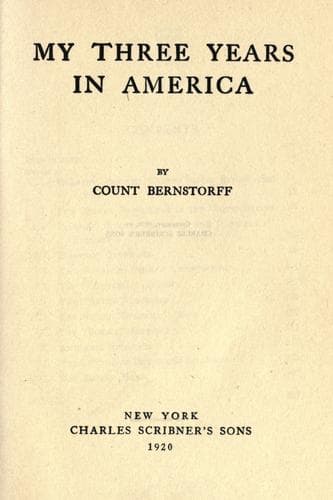
My Three Years in AmericaBernstorff, Johann Heinrich, Graf von
History
My Three Years in America
Bernstorff, Johann Heinrich, Graf von
Germany -- Foreign relations -- United States; United States -- Foreign relations -- Germany; World War, 1914-1918
As the necessary means for carrying through the scheme could not be
raised it might have been possible to finance it if the Government
had taken over the not inconsiderable funds of the German banks and
the great industrial enterprises, e.g., the chemical factories in
the United States, and used them for the shipments. The suggestions
we made to this effect were not answered until the end of August,
when we arrived in New York and had already lost many weeks in
trying to negotiate the loan. One organ, which immediately after
the war had taken up these questions on its own initiative, failed,
and so nothing was done in the whole wide sphere of credit, supply
of raw materials and foodstuffs and shipping until my arrival with
the other gentlemen, so that the most favorable opportunity was lost.
Remittances from Germany did not arrive until long afterwards, and
then only to a very modest extent. Consequently the whole economic
scheme was considerably narrowed and hampered from the beginning.
The second assumption, that the United States, in consideration
of her great commercial connections with Germany, would maintain
her rights as a neutral State to unrestricted sea trade within the
provisions of international law, proved to be unfounded. The United
States, at any rate according to the view of some very distinguished
Americans, as, for example, in the journal _New Republic_, violated
the spirit of neutrality when she allowed commerce of the neutrals
one with another to be strangled by England. To the interest in
traffic with the neutral States, and indirectly with Germany, was
opposed the interest in the still greater trade with our enemies,
to which was added, and indeed to a rapidly increasing extent,
the supply of war material. The United States did not realize the
extent of their economic power in respect of England, as the
inexperienced, newly-appointed Democratic Government had no statistics
to which to refer, and from a military point of view were defenceless
for want of an army or fleet. So England was able, slowly and
cautiously, but surely, to cut off the Central Powers from the
American market. In view of this state of things the important
thing was to pass all shipments off as neutral. The exporter had
to be an American or a subject of neutral Europe. The financing
had also to be European, at any rate outwardly. The destination
could only be a port in Holland, Scandinavia, Spain or--at that
time--Italy. Consequently it was not long before the consignments
could no longer be made through the New York representative of
the Hamburg-Amerika line, but were taken in hand by Herr Albert
himself, who merely availed himself of the professional advice
of the Hamburg-Amerika line.
Public-domain text, read in full here on John Shaqi.
Reviews
Reviews
No reviews yet
Be the first to share your thoughts on this work.
Join the Discussion
Join the discussion
Sign in to leave a comment or review.
Sign InorCreate an account