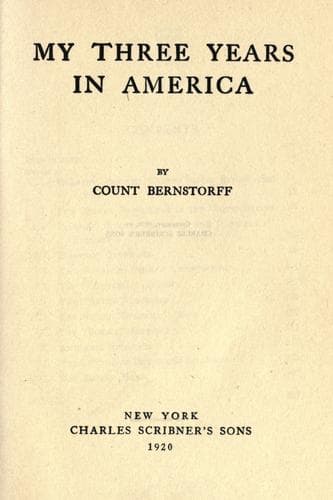
My Three Years in AmericaBernstorff, Johann Heinrich, Graf von
History
My Three Years in America
Bernstorff, Johann Heinrich, Graf von
Germany -- Foreign relations -- United States; United States -- Foreign relations -- Germany; World War, 1914-1918
Anyone who has lived some time in the United States will feel with
Goethe that "America is better off than our own Continent." Owing to
the almost perfect autarchy existing there, grave economic problems
never really arise. Nowhere else, during the whole course of my
various diplomatic wanderings, have I ever seen a happier people, who
looked more cheerfully into the future. In view of the comparatively
sparse population of the country, intensive agricultural production
has only become necessary in a few isolated districts; there are
always purchasers in plenty for the rich surplus of raw materials
available, and industry has not yet been directed solely towards
export. As a result of these happy conditions, the American citizen
feels but little interest for what goes on in other countries. In
the period preceding the Five-Years War, if the political interests
of the United States ever happened to cross those of Europe, it was
almost exclusively in regard to American questions. As a proof
of this we have only to think of the Spanish-American War, and of
the various incidents relating to Venezuela; whereas it was only
with difficulty that the German Government succeeded in inducing
President Roosevelt's Administration to take part in the Algeciras
Conference, at which the presence of the United States representative
in no way alleviated our task.
Up to the time of the Five-Years War, the Foreign Policy conducted
from Washington was almost entirely Pan-American, and the Monroe
Doctrine was the beginning and end of it; for even if that versatile
man, President Roosevelt, was fond of extending his activities to
other spheres, as, for instance, when he brought the Russo-Japanese
War to an end by the Peace of Portsmouth, the Panama Canal scheme
remained his favorite child. But in the case of the Russo-Japanese
War, it was home politics, which in America are chiefly responsible
for turning the scales in regard to Foreign Policy, that again
played the principal part. Mr. Roosevelt wished to win over to
his side the very strong pacifist element in America; whereas the
Imperialists--particularly later on--deprecated these successful
attempts at mediation, because they prevented a further weakening
of both of the belligerent parties. Even Roosevelt's Secretary of
State, John Hay, concerned himself actively with the Far East,
and was known in America as the spiritual founder of the policy of
the "Open Door." In this particular matter, the German Government
frequently acted hand in hand with the American, and it was owing
to this circumstance that the Foreign Office at Berlin very much
wished to have the United States represented at the Algeciras
Conference. The German Government believed that the Americans would
also declare themselves in favor of the "Open Door" even in Morocco.
This assumption, however, turned out to be a false one, owing to
the fact that the political and economic interest shown by the
Public-domain text, read in full here on John Shaqi.
Reviews
Reviews
No reviews yet
Be the first to share your thoughts on this work.
Join the Discussion
Join the discussion
Sign in to leave a comment or review.
Sign InorCreate an account