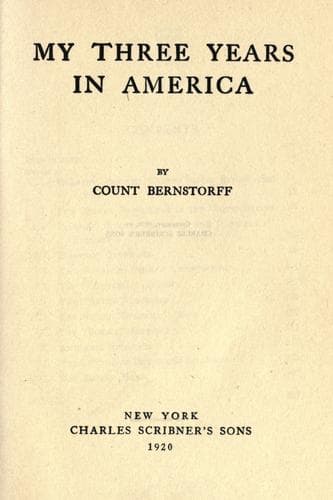
My Three Years in AmericaBernstorff, Johann Heinrich, Graf von
History
My Three Years in America
Bernstorff, Johann Heinrich, Graf von
Germany -- Foreign relations -- United States; United States -- Foreign relations -- Germany; World War, 1914-1918
My policy might best be described as that of "a silent resolve to
obtain Peace." It was utterly wrong to publish our readiness for
Peace broadcast. We should have presented a strong front to the
outside world, and we should have increased the powers of resistance
which we actually possessed by emphasizing our strength both to
our people at home and to other States. According to my view, we
ought, after the first battle of the Marne, to have recognized
in our heart of hearts that victory was out of the question, and
consequently we should have striven to conclude a Peace, the relatively
unfavorable terms of which might perhaps have temporarily staggered
public opinion in Germany and created some indignation. It was not
right, however, to allow deference to public opinion to outweigh
other considerations, as it did in our case. The political leaders
of the Empire ought to have kept the High Military Command, which
from its point of view naturally demanded firmer "assurances" than
the general situation warranted, more thoroughly within bounds,
just as Bismarck did. Presumably the High Military Command would
have been able to perform its duties quite as efficiently if it
had been prevented from exercising too much influence on the policy
which aimed at a conclusion of peace.
As a politician I consider that the ultimate cause of our misfortune
was our lack of a uniform policy both before and during the war.
If, at the time of Bismarck's retirement, we had made a timely
and resolute decision either in favor of the Western Policy that
he advocated, or in favor of the Eastern Policy, we should have
prevented the development of a situation in the politics of the
world which ultimately led to our own undoing. If, during the war,
however, we had completely abandoned the U-boat campaign, and had
made every possible effort to come to an understanding with America,
we should, in my opinion, have been able to extricate ourselves
from it satisfactorily. Be this as it may, it is also possible
that if the U-boat campaign had been prosecuted resolutely, and
without any shilly-shallying--a thing I never wished--we should not
have suffered so complete a collapse from the military, economic,
political and moral point of view, as we must otherwise have done.
According to my view it is the hesitating zigzag course that we
pursued which is chiefly to blame for the fact that of all possible
results of the epoch of German world-politics, the unhappiest for
ourselves has come to pass. The Wilhelminian Age perished owing to
the fact that no definite objects were either selected or pursued
in good time, and, above all, because both before and during the
war, two systems in the Government of the country were constantly
at variance with each other and mutually corroding.
CHAPTER I
GERMANY AND THE UNITED STATES BEFORE THE WAR
Public-domain text, read in full here on John Shaqi.
Reviews
Reviews
No reviews yet
Be the first to share your thoughts on this work.
Join the Discussion
Join the discussion
Sign in to leave a comment or review.
Sign InorCreate an account