Mysteries of Bee-keeping ExplainedQuinby, M. (Moses)
Science
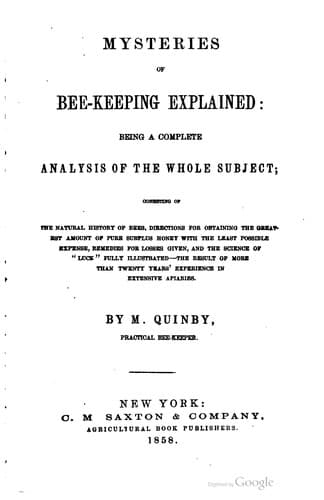
Mysteries of Bee-keeping Explained
Quinby, M. (Moses)
Bees
Why the word luck is applied to Bees, 362
Rule in taking Bees for a share, 364
A man may sell his "luck," 364
First-rate stocks recommended to begin with, 365
Old stocks are good as any if healthy, 365
Caution respecting diseased brood, 366
Result of ignorance in purchasing, 366
Size of Hives important, 367
How large Hives can be made smaller, 368
Moderate weather best to remove Bees, 369
Preparations for transporting Bees, 370
Securing Bees in the Hive, 370
Best Conveyance, 370
Hive to be inverted, 371
Conclusion, 372
PREFACE.
Before the reader decides that an apology is necessary for the
introduction of another work on bees into the presence of those already
before the public, it is hoped that he will have the patience to
examine the contents of this.
The writer of the following pages commenced beekeeping in 1828, without
any knowledge of the business to assist him, save a few directions
about hiving, smoking them with sulphur, &c. Nearly all the information
to be had was so mingled with erroneous whims and notions, that it
required a long experience to separate essential and consistent points.
It was _impossible_ to procure a work that gave the information
necessary for practice. From that time to the present, no sufficient
guide for the inexperienced has appeared. European works, republished
here, are of but little value. Weeks, Townley, Miner, and others,
writers of this country, within a few years, have given us treatises,
valuable to some extent, but have entirely neglected several chapters,
very important and essential to the beginner. Keeping bees _has_ been,
and is now, by the majority, deemed a hazardous enterprise. The ravages
of the moth had been so great, and loss so frequent, that but little
attention was given to the subject for a long time. Mr. Weeks lost his
entire stock three times in fifteen years. But soon after the discovery
was promulgated, that honey could be taken from a stock without
destroying the bees, an additional attention was manifest, increasing
to a rage in many places. It seems to be easily understood, that
_profit_ must attend success, in this branch of the farmer's stock;
inasmuch as the "bees work for nothing and find themselves." This
interest in bees should be encouraged to continue till enough are kept
to collect all the honey now wasted; which, compared with the present
collections, would be more than a thousand pounds to one. But to
succeed, that is the difficulty. Some eighteen years since, after a
Public-domain text, read in full here on John Shaqi.
Reviews
Reviews
No reviews yet
Be the first to share your thoughts on this work.
Join the Discussion
Join the discussion
Sign in to leave a comment or review.
Sign InorCreate an account