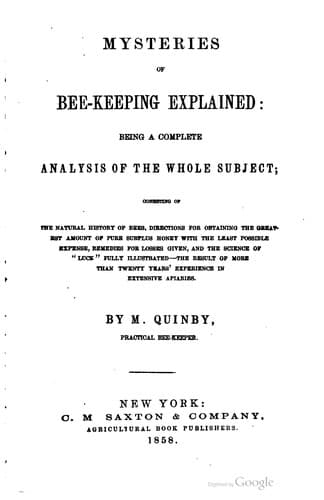
Mysteries of Bee-keeping ExplainedQuinby, M. (Moses)
Science
Mysteries of Bee-keeping Explained
Quinby, M. (Moses)
Bees
propitious season, an aged and esteemed friend said to me, "It is not
to be expected that you will have such luck always; you must expect
they will run out after a time. I have always noticed, when people have
first-rate luck for a time, that the bees generally take a turn, and
are gone in a few years."
I am not sure but, to the above remarks, may be traced the cause of my
subsequent success. It stimulated me to observation and inquiry. I soon
found that good seasons were the "lucky" ones, and that many lost in an
adverse season, all they had before gained. Also, that strong families
were the only ones on which I could depend for protection against the
moth. This induced the effort to ascertain causes tending to diminish
the size of families, and the application of remedies. Whether success
has attended my efforts or not, the reader can judge, after a perusal
of the work.
It is time that the word "_luck_," as applied to beekeeping, was
discarded. The prevailing opinion, that bees will prosper for one
person more than another, under the same circumstances, is fallacious.
As well might it be applied to the mechanic and farmer. The careless,
ignorant farmer, might occasionally succeed in raising a crop with a
poor fence; but would be liable, at any time, to lose it by trespassing
cattle. He might have suitable soil in the beginning, but without
knowledge, for the proper application of manures, it might fail to
produce; unless a _chance_ application _happened_ to be right.
But with the _intelligent_ farmer the case is different: fences in
order, manures judiciously applied, and with propitious seasons, he
makes a sure thing of it. Call him "_lucky_" if you please; it is his
knowledge, and care, that render him so. So with bee-keeping, the
careful man is the "lucky" one. There can be no effect without a
preceding cause. If you lose a stock of bees, there is a cause or
causes producing it, just as certain as the failure of a crop with the
unthrifty farmer, can be traced to a poor fence, or unfruitful soil.
You may rest assured, that a rail is off your fence of management
somewhere, or the proper applications have not been made. In relation
to bees, these things may not be quite so apparent, yet nevertheless
true. Why is there so much more uncertainty in apiarian science than
other farming operations? It must be attributed to the fact, that among
the thousands who are engaged in, and have studied agriculture, perhaps
not more than one has given his energies to the nature and habits of
bees. If knowledge is elicited in the same ratio, we ought to have a
thousand times more light on one subject than the other, and still
there are some things, even in agriculture, that may yet be learned.
Public-domain text, read in full here on John Shaqi.
Reviews
Reviews
No reviews yet
Be the first to share your thoughts on this work.
Join the Discussion
Join the discussion
Sign in to leave a comment or review.
Sign InorCreate an account