Mysteries of Bee-keeping ExplainedQuinby, M. (Moses)
Science
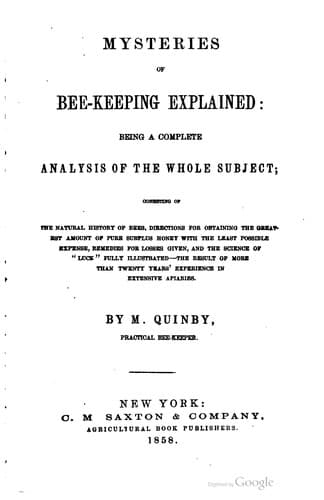
Mysteries of Bee-keeping Explained
Quinby, M. (Moses)
Bees
It is supposed, by many, that we already have all the knowledge that
the subject of _bees_ affords. This is not surprising; a person that
was never furnished with a full treatise, might arrive at such
conclusions. Unless his own experience goes deeper, he can have no
means of judging what is yet behind.
In conversation relative to this work, with a person of considerable
scientific attainments, he remarked, "You do not want to give the
natural history of bees at all; that is already sufficiently
understood." And how is it understood; as Huber gives it, or in
accordance with some of our own writers? If we take Huber as a guide,
we find many points recently contradicted. If we compare authors of our
day, we find them contradicting each other. One recommends a peculiarly
constructed hive, as just the thing adapted to their nature and
instincts. If a single point is in accordance with their nature, he
labors to twist all the others to his purpose, although it may involve
a fundamental principle impossible to reconcile. Some one else succeeds
in another point, and proceeds to recommend something altogether
different. False and contradictory assertions are made either through
ignorance, or interest. Interest may blind the judgment, and spurious
history may deceive.
It is folly to expect success in bee-keeping for any length of time,
without a correct knowledge of their nature and instincts; and this we
shall never obtain by the course hitherto pursued. As much of their
labor is performed in the dark, and difficult to be observed, it has
given rise to conjecture and false reasoning, leading to false
conclusions.
When _I_ say a thing _is so_, or say it is _not so_, what evidence has
the reader that it is proved or demonstrated? _My_ mere assertions are
not expected to be taken in preference to another's; of such proof, we
have more than enough. Most people have not the time, patience, or
ability, to set down quietly with close observation, and investigate
the subject thoroughly. Hence it has been found easier to receive error
for truth, than to make the exertion necessary to confute it; the more
so, because there is no guide to direct the investigation. I shall,
therefore, pursue a different course; and for every _assertion_
endeavor to give a test, that the reader may apply and satisfy himself,
and trust to no one. As for theories, I shall try to keep them separate
from facts, and offer such evidence as I have, either for or against
them. If the reader has further proof that presents the matter in
another light, of course he will exercise the right to a difference of
opinion.
Public-domain text, read in full here on John Shaqi.
Reviews
Reviews
No reviews yet
Be the first to share your thoughts on this work.
Join the Discussion
Join the discussion
Sign in to leave a comment or review.
Sign InorCreate an account