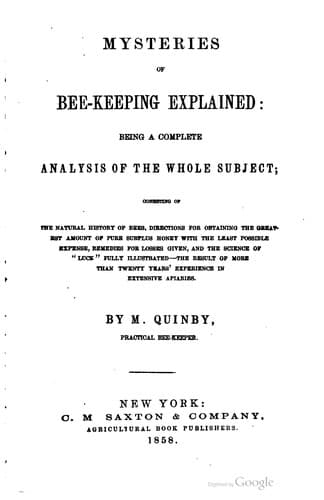
Mysteries of Bee-keeping ExplainedQuinby, M. (Moses)
Science
Mysteries of Bee-keeping Explained
Quinby, M. (Moses)
Bees
Before you turn over the old stock, look among the combs as far as
possible for queens' cells; if any contain eggs or larvæ, you may
safely risk their rearing a queen; but otherwise wait till next
morning, or at least twenty-four hours, then go to a stock that has
cast a swarm, and obtain a finished royal cell, as before directed, and
introduce it. You will have a queen here as soon as if it had been left
in the original hive, and no risk of an after swarm, because there is
but one. But when there are young queens in the cells at the time of
driving, after swarms may issue. Should a queen-cell be introduced
immediately, it is more liable to be destroyed than after waiting
twenty-four hours; and then is not always safe. After it has had time
to hatch, (which is about eight days after being sealed), cut it out,
and examine it: if the lower end is open, it indicates that a perfect
queen has left it, and all is safe; but if it is mutilated or open at
the side, it is probable that the queen was destroyed before maturity,
in which case, another cell will have to be given them.
ARTIFICIAL SWARMS ONLY SAFE NEAR THE SWARMING SEASON.
By what I have said about artificial swarms, it would appear that it is
unsafe at any time but the swarming season; that is my opinion. It may
do a little in advance or a little after, providing royal cells can be
had. By feeding as directed, (in Chapter IX.) you may induce a stock to
send out a swarm some days in advance of the regular season, thereby
giving you a chance for these cells somewhat early.
SOMETIMES HAZARDOUS.
To make such swarms at any time when the bees are destroying drones,
would be extremely hazardous, not only on account of the young queen
being impregnated, but their massacre denotes a scarcity of honey.
Therefore I would advise never to make swarms, or drive out bees at
such periods, when it can be avoided, without spare honey is on hand to
feed them.
SOME OBJECTIONS.
It has been argued by some, and with much reason, that "nature is the
best guide, and it is better to let the bees have their own way about
swarming--if honey is abundant, and the stock is in condition to spare
a swarm, their own instincts will teach them to construct royal cells;
if it fails before they are ready, and the royal brood is destroyed, it
is because the existence of the swarm would be precarious, and it is
best not to issue." I will grant that in many instances it is better.
The chance is better for surplus honey; the stock is quite sure to be
in condition to winter; and some judgment is required to tell when a
stock can spare a swarm.
Public-domain text, read in full here on John Shaqi.
Reviews
Reviews
No reviews yet
Be the first to share your thoughts on this work.
Elsewhere in the archive
Join the Discussion
Join the discussion
Sign in to leave a comment or review.
Sign InorCreate an account