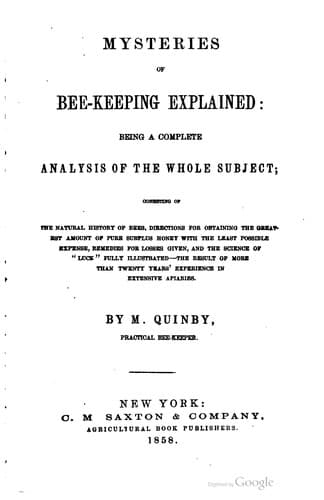
Mysteries of Bee-keeping ExplainedQuinby, M. (Moses)
Science
Mysteries of Bee-keeping Explained
Quinby, M. (Moses)
Bees
But yet, we are sometimes anxious to increase our stocks to the utmost
that safety will allow, and often have some that can spare a swarm as
well as not, but refuse to leave; perhaps commence preparations, and in
a few days abandon them. Now it is evident that as long as many
continue such preparation, that honey is sufficiently abundant to put
the safety of the swarm beyond hazard; some stocks will swarm while
these others just as good, (that had abandoned it before) and have not
now begun again, to be in time before a partial failure of honey, and
some may not have commenced in season.
NATURAL AND ARTIFICIAL SWARMS EQUALLY PROSPEROUS.
I can see no difference in artificial or natural swarms of equal size,
at the same time. By taking the matter in time into our own hands, with
the rules given, we make a sure thing of it, that is, we are sure to
get the swarms, when if left to the bees it would be uncertain, and no
greater risk afterwards than with natural issues.
THIS MATTER TOO OFTEN DELAYED.
I am aware that this matter will be apt to be put off too long; "wait
and see if they don't swarm," will be the motto of too many, and when
the season is over, drive them. Perhaps a good swarm has set outside
the hive, all through the best of the honey season, and done nothing,
while they could have half filled a hive; but this is all lost now, as
well as the best chances for getting cells. Let me impress the
necessity of doing it in season, when it will pay. If you intend to
have a swarm from every stock that can spare one, begin when nature
points out the proper time, which is, when the regular ones begin to
issue. It must, indeed, be a poor season when there are none.
IS THE AGE OF THE QUEEN IMPORTANT?
There is another object effected in this way, considered by some
apiarians as very important. It is the change of the queens in the old
stock. A young queen is thought to be "much more prolific than an old
one." They even recommend keeping none "over two or three years old,"
and give directions how they may be renewed. But as I have been unable
to discover any difference in relation to the age in this respect, I
shall not at present take much time to discuss it. It is well enough,
when we can take our choice without trouble, to preserve a young queen.
When we consider that there are but few queens but what will deposit
three times as many eggs in a season as are matured, it looks as if it
would hardly pay to take much trouble to change them. At what time the
queen becomes barren from old age, I presume has never yet been fully
determined.
Public-domain text, read in full here on John Shaqi.
Reviews
Reviews
No reviews yet
Be the first to share your thoughts on this work.
Elsewhere in the archive
Join the Discussion
Join the discussion
Sign in to leave a comment or review.
Sign InorCreate an account