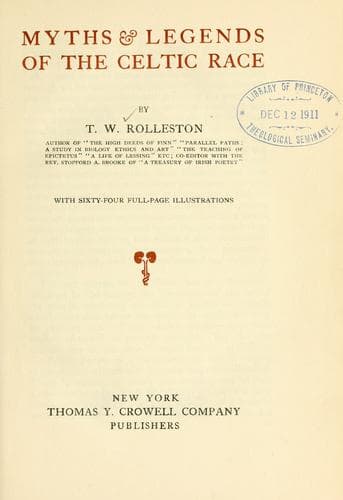
Myths & Legends of the Celtic RaceRolleston, T. W. (Thomas William)
Religion
Myths & Legends of the Celtic Race
Rolleston, T. W. (Thomas William)
Celts -- Religion; Mythology, Celtic
The Celtic culture illustrated by the remains at Hallstatt developed later
into what is called the La Tène culture. La Tène was a settlement at the
north-eastern end of the Lake of Neuchâtel, and many objects of great
interest have been found there since the site was first explored in 1858.
These antiquities represent, according to Dr. Evans, the culminating
period of Gaulish civilisation, and date from round about the third
century B.C. The type of art here found must be judged in the light of an
observation recently made by Mr. Romilly Allen in his “Celtic Art” (p.
13):
“The great difficulty in understanding the evolution of Celtic art lies in
the fact that although the Celts never seem to have invented any new
ideas, they possessed an extraordinary aptitude for picking up ideas from
the different peoples with whom war or commerce brought them into contact.
And once the Celt had borrowed an idea from his neighbours he was able to
give it such a strong Celtic tinge that it soon became something so
different from what it was originally as to be almost unrecognisable.”
Now what the Celt borrowed in the art-culture which on the Continent
culminated in the La Tène relics were certain originally naturalistic
motives for Greek ornaments, notably the palmette and the meander motives.
But it was characteristic of the Celt that he avoided in his art all
imitation of, or even approximation to, the natural forms of the plant and
animal world. He reduced everything to pure decoration. What he enjoyed in
decoration was the alternation of long sweeping curves and undulations
with the concentrated energy of close-set spirals or bosses, and with
these simple elements and with the suggestion of a few motives derived
from Greek art he elaborated a most beautiful, subtle, and varied system
of decoration, applied to weapons, ornaments, and to toilet and household
appliances of all kinds, in gold, bronze, wood, and stone, and possibly,
if we had the means of judging, to textile fabrics also. One beautiful
feature in the decoration of metal-work seems to have entirely originated
in Celtica. Enamelling was unknown to the classical nations till they
learned from the Celts. So late as the third century A.D. it was still
strange to the classical world, as we learn from the reference of
Philostratus:
“They say that the barbarians who live in the ocean [Britons] pour
these colours upon heated brass, and that they adhere, become hard
as stone, and preserve the designs that are made upon them.”
Dr. J. Anderson writes in the “Proceedings of the Society of Antiquaries
of Scotland”:
Public-domain text, read in full here on John Shaqi.
Reviews
Reviews
No reviews yet
Be the first to share your thoughts on this work.
Join the Discussion
Join the discussion
Sign in to leave a comment or review.
Sign InorCreate an account