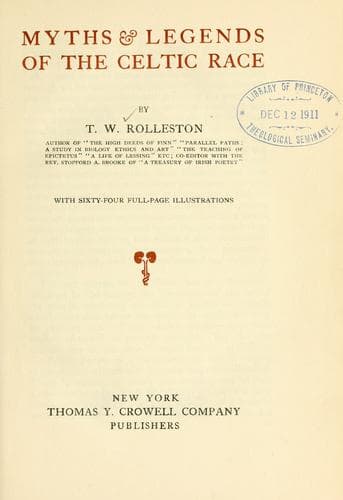
Myths & Legends of the Celtic RaceRolleston, T. W. (Thomas William)
Religion
Myths & Legends of the Celtic Race
Rolleston, T. W. (Thomas William)
Celts -- Religion; Mythology, Celtic
The word _dunum_, so often traceable in Gaelic place-names in the present
day (Dundalk, Dunrobin, &c.), and meaning fortress or castle, is another
typically Celtic element in European place-names. It occurred very
frequently in France—_e.g., Lug-dunum_ (Lyons), _Viro-dunum_ (Verdun). It
is also found in Switzerland—_e.g., Minno-dunum_ (Moudon), _Eburo-dunum_
(Yverdon)—and in the Netherlands, where the famous city of Leyden goes
back to a Celtic _Lug-dunum._ In Great Britain the Celtic term was often
changed by simple translation into _castra_; thus _Camulo-dunum_ became
Colchester, _Brano-dunum_ Brancaster. In Spain and Portugal eight names
terminating in _dunum_ are mentioned by classical writers. In Germany the
modern names Kempton, Karnberg, Liegnitz, go back respectively to the
Celtic forms _Cambo-dunum, Carro-aunum,_ _Lugi-dunum_, and we find a
_Singi-dunum,_ now Belgrade, in Servia, a _Novi-dunum_, now Isaktscha, in
Roumania, a _Carro-dunum_ in South Russia, near the Dniester, and another
in Croatia, now Pitsmeza. _Sego-dunum_, now Rodez, in France, turns up
also in Bavaria (Wurzburg), and in England (_Sege-dunum,_ now Wallsend, in
Northumberland), and the first term, _sego_, is traceable in Segorbe
(_Sego-briga_) in Spain. _Briga_ is a Celtic word, the origin of the
German _burg_, and equivalent in meaning to _dunum_.
One more example: the word _magos_, a plain, which is very frequent as an
element of Irish place-names, is found abundantly in France, and outside
of France, in countries no longer Celtic, it appears in Switzerland
(_Uro-magus_ now Promasens), in the Rhineland (_Broco-magus_, Brumath), in
the Netherlands, as already noted (Nimègue), in Lombardy several times,
and in Austria.
The examples given are by no means exhaustive, but they serve to indicate
the wide diffusion of the Celts in Europe and their identity of language
over their vast territory.(16)
*Early Celtic Art*
The relics of ancient Celtic art-work tell the same story. In the year
1846 a great pre-Roman necropolis was discovered at Hallstatt, near
Salzburg, in Austria. It contains relics believed by Dr. Arthur Evans to
date from about 750 to 400 B.C. These relics betoken in some cases a high
standard of civilisation and considerable commerce. Amber from the Baltic
is there, Phoenician glass, and gold-leaf of Oriental workmanship. Iron
swords are found whose hilts and sheaths are richly decorated with gold,
ivory, and amber.
Public-domain text, read in full here on John Shaqi.
Reviews
Reviews
No reviews yet
Be the first to share your thoughts on this work.
Join the Discussion
Join the discussion
Sign in to leave a comment or review.
Sign InorCreate an account