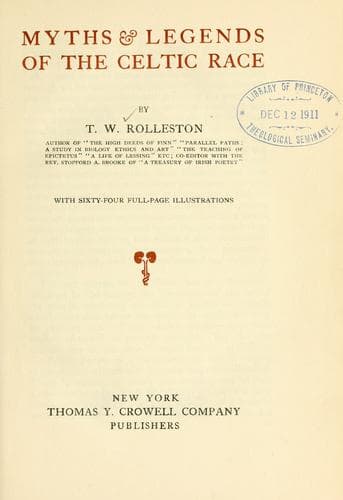
Myths & Legends of the Celtic RaceRolleston, T. W. (Thomas William)
Religion
Myths & Legends of the Celtic Race
Rolleston, T. W. (Thomas William)
Celts -- Religion; Mythology, Celtic
Let us begin by saying that the reader will find himself in an altogether
different atmosphere from that in which the heroes of the Ultonian Cycle
live and move. Everything speaks of a later epoch, when life was gentler
and softer, when men lived more in settlements and towns, when the Danaan
Folk were more distinctly fairies and less deities, when in literature the
elements of wonder and romance predominated, and the iron string of
heroism and self-sacrifice was more rarely sounded. There is in the
Ossianic literature a conscious delight in wild nature, in scenery, in the
song of birds, the music of the chase through the woods, in mysterious and
romantic adventure, which speaks unmistakably of a time when the free,
open-air life “under the greenwood tree” is looked back on and idealised,
but no longer habitually lived, by those who celebrate it. There is also a
significant change of _locale_. The Conorian tales were the product of a
literary movement having its sources among the bleak hills or on the stern
rock-bound coasts of Ulster. In the Ossianic Cycle we find ourselves in
the Midlands or South of Ireland. Much of the action takes place amid the
soft witchery of the Killarney landscape, and the difference between the
two regions is reflected in the ethical temper of the tales.
In the Ultonian Cycle it will have been noticed that however extravagantly
the supernatural element may be employed, the final significance of almost
every tale, the end to which all the supernatural machinery is worked, is
something real and human, something that has to do with the virtues or
vices, the passions or the duties or men and women. In the Ossianic Cycle,
broadly speaking, this is not so. The nobler vein of literature seems to
have been exhausted, and we have now beauty for the sake of beauty,
romance for the sake of romance, horror or mystery for the sake of the
excitement they arouse. The Ossianic tales are, at their best,
“Lovely apparitions, sent To be a moment’s ornament.”
They lack that something, found in the noblest art as in the noblest
personalities, which has power “to warn, to comfort, and command.”
*The Coming of Finn*
King Cormac mac Art was certainly a historical character, which is more,
perhaps, than we can say of Conor mac Nessa. Whether there is any real
personage behind the glorious figure of his great captain, Finn, it is
more difficult to say. But for our purpose it is not necessary to go into
this question. He was a creation of the Celtic mind in one land and in one
stage of its development, and our part here is to show what kind of
character the Irish mind liked to idealise and make stories about.
Public-domain text, read in full here on John Shaqi.
Reviews
Reviews
No reviews yet
Be the first to share your thoughts on this work.
Elsewhere in the archive
Join the Discussion
Join the discussion
Sign in to leave a comment or review.
Sign InorCreate an account