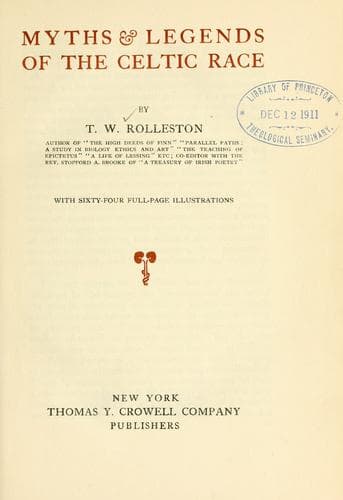
Myths & Legends of the Celtic RaceRolleston, T. W. (Thomas William)
Religion
Myths & Legends of the Celtic Race
Rolleston, T. W. (Thomas William)
Celts -- Religion; Mythology, Celtic
The true term for the population of these islands, and for the typical and
dominant part of the population of North America, is not Anglo-Saxon, but
Anglo-Celtic. It is precisely in this blend of Germanic and Celtic
elements that the British people are unique—it is precisely this blend
which gives to this people the fire, the _élan_, and in literature and art
the sense of style, colour, drama, which are not common growths of German
soil, while at the same time it gives the deliberateness and depth, the
reverence for ancient law and custom, and the passion for personal
freedom, which are more or less strange to the Romance nations of the
South of Europe. May they never become strange to the British Islands! Nor
is the Celtic element in these islands to be regarded as contributed
wholly, or even very predominantly, by the populations of the so-called
“Celtic Fringe.” It is now well known to ethnologists that the Saxons did
not by any means exterminate the Celtic or Celticised populations whom
they found in possession of Great Britain. Mr. E.W.B. Nicholson, librarian
of the Bodleian, writes in his important work “Keltic Researches” (1904):
“Names which have not been purposely invented to describe race must never
be taken as proof of race, but only as proof of community of language, or
community of political organisation. We call a man who speaks English,
lives in England, and bears an obviously English name (such as Freeman or
Newton), an Englishman. Yet from the statistics of ‘relative nigrescence’
there is good reason to believe that Lancashire, West Yorkshire,
Staffordshire, Worcestershire, Warwickshire, Leicestershire, Rutland,
Cambridgeshire, Wiltshire, Somerset, and part of Sussex are as Keltic as
Perthshire and North Munster; that Cheshire, Shropshire, Herefordshire,
Monmouthshire, Gloucestershire, Devon, Dorset, Northamptonshire,
Huntingdonshire, and Bedfordshire are more so—and equal to North Wales and
Leinster; while Buckinghamshire and Hertfordshire exceed even this degree,
and are on a level with South Wales and Ulster.”(1)
It is, then, for an Anglo-Celtic, not an “Anglo-Saxon,” people that this
account of the early history, the religion, and the mythical and romantic
literature of the Celtic race is written. It is hoped that that people
will find in it things worthy to be remembered as contributions to the
general stock of European culture, but worthy above all to be borne in
mind by those who have inherited more than have any other living people of
the blood, the instincts and the genius of the Celt.
CONTENTS
PREFACE
CHAPTER I: THE CELTS IN ANCIENT HISTORY
CHAPTER II: THE RELIGION OF THE CELTS
CHAPTER III: THE IRISH INVASION MYTHS
CHAPTER IV: THE EARLY MILESIAN KINGS
CHAPTER V: TALES OF THE ULTONIAN CYCLE
CHAPTER VI: TALES OF THE OSSIANIC CYCLE
CHAPTER VII: THE VOYAGE OF MAELDUN
CHAPTER VIII: MYTHS AND TALES OF THE CYMRY
ILLUSTRATIONS
Public-domain text, read in full here on John Shaqi.
Reviews
Reviews
No reviews yet
Be the first to share your thoughts on this work.
Join the Discussion
Join the discussion
Sign in to leave a comment or review.
Sign InorCreate an account