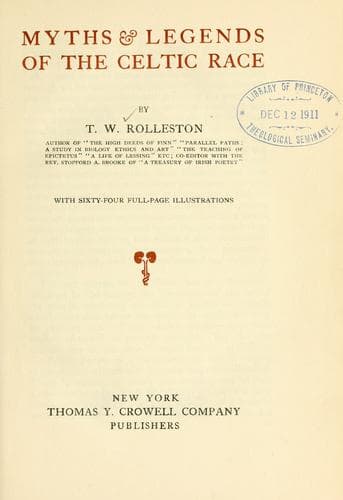
Myths & Legends of the Celtic RaceRolleston, T. W. (Thomas William)
Religion
Myths & Legends of the Celtic Race
Rolleston, T. W. (Thomas William)
Celts -- Religion; Mythology, Celtic
Queen Maev
Prehistoric Tumulus at New Grange
Stone Alignments at Kermaris, Carnac
Stone-worship at Locronan, Brittany
CHAPTER I: THE CELTS IN ANCIENT HISTORY
*Earliest References*
In the chronicles of the classical nations for about five hundred years
previous to the Christian era there are frequent references to a people
associated with these nations, sometimes in peace, sometimes in war, and
evidently occupying a position of great strength and influence in the
Terra Incognita of Mid-Europe. This people is called by the Greeks the
Hyperboreans or Celts, the latter term being first found in the geographer
Hecatæsus, about 500 B.C.(2)
Herodotus, about half a century later, speaks of the Celts as dwelling
“beyond the pillars of Hercules”—_i.e._, in Spain—and also of the Danube
as rising in their country.
Aristotle knew that they dwelt “beyond Spain,” that they had captured
Rome, and that they set great store by warlike power. References other
than geographical are occasionally met with even in early writers.
Hellanicus of Lesbos, an historian of the fifth century B.C., describes
the Celts as practising justice and righteousness. Ephorus, about 350
B.C., has three lines of verse about the Celts in which they are described
as using “the same customs as the Greeks”—whatever that may mean—and being
on the friendliest terms with that people, who established guest
friendships among them. Plato, however, in the “Laws,” classes the Celts
among the races who are drunken and combative, and much barbarity is
attributed to them on the occasion of their irruption into Greece and the
sacking of Delphi in the year 273 B.C. Their attack on Rome and the
sacking of that city by them about a century earlier is one of the
landmarks of ancient history.
Public-domain text, read in full here on John Shaqi.
Reviews
Reviews
No reviews yet
Be the first to share your thoughts on this work.
Join the Discussion
Join the discussion
Sign in to leave a comment or review.
Sign InorCreate an account