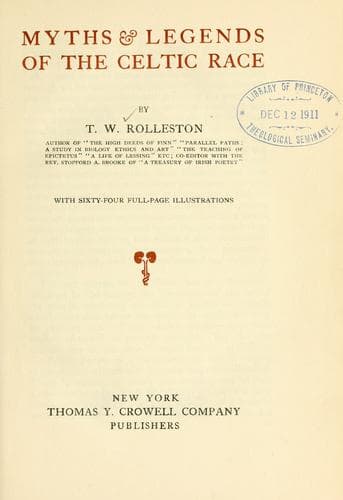
Myths & Legends of the Celtic RaceRolleston, T. W. (Thomas William)
Religion
Myths & Legends of the Celtic Race
Rolleston, T. W. (Thomas William)
Celts -- Religion; Mythology, Celtic
This remarkable incident has been described at some length because it is
typical of a factor whose profound influence in moulding the history of
the Celtic peoples we can trace through a succession of critical events
from the time of Julius Caesar to the present day. How and whence it arose
we shall consider later; here it is enough to call attention to it. It is
a factor which forbade the national development of the Celts, in the sense
in which we can speak of that of the classical or the Teutonic peoples.
*What Europe Owes to the Celt*
Yet to suppose that on this account the Celt was not a force of any real
consequence in Europe would be altogether a mistake. His contribution to
the culture of the Western world was a very notable one. For some four
centuries—about A.D. 500 to 900—Ireland was the refuge of learning and the
source of literary and philosophic culture for half Europe. The
verse-forms of Celtic poetry have probably played the main part in
determining the structure of all modern verse. The myths and legends of
the Gaelic and Cymric peoples kindled the imagination of a host of
Continental poets. True, the Celt did not himself create any great
architectural work of literature, just as he did not create a stable or
imposing national polity. His thinking and feeling were essentially
lyrical and concrete. Each object or aspect of life impressed him vividly
and stirred him profoundly; he was sensitive, impressionable to the last
degree, but did not see things in their larger and more far-reaching
relations. He had little gift for the establishment or institutions, for
the service of principles; but he was, and is, an indispensable and
never-failing assertor of humanity as against the tyranny of principles,
the coldness and barrenness of institutions. The institutions of royalty
and of civic patriotism are both very capable of being fossilised into
barren formulae, and thus of fettering instead of inspiring the soul. But
the Celt has always been a rebel against anything that has not in it the
breath of life, against any unspiritual and purely external form of
domination. It is too true that he has been over-eager to enjoy the fine
fruits of life without the long and patient preparation for the harvest,
but he has done and will still do infinite service to the modern world in
insisting that the true fruit of life is a spiritual reality, never
without pain and loss to be obscured or forgotten amid the vast mechanism
of a material civilisation.
CHAPTER II: THE RELIGION OF THE CELTS
*Ireland and the Celtic Religion*
We have said that the Irish among the Celtic peoples possess the unique
interest of having carried into the light of modern historical research
many of the features of a native Celtic civilisation. There is, however,
one thing which they did not carry across the gulf which divides us from
the ancient world—and this was their religion.
Public-domain text, read in full here on John Shaqi.
Reviews
Reviews
No reviews yet
Be the first to share your thoughts on this work.
Join the Discussion
Join the discussion
Sign in to leave a comment or review.
Sign InorCreate an account